In the two-person dynamics of tango, leader and follower do not align by verbal command. Each maintains an intrinsic rhythm of their own, and through the contact surface at the sternum they exchange force and displacement, pressing the phase difference bit by bit into the phase-locking bandwidth; once it can no longer be held, the step pattern breaks up into beating: now fast, now slow, returning again and again to the same point of misalignment. Marriage matching deals with the same class of problem.
In *Bazi Marriage-Matching Theory I/II*, Ou Yue defines marriage as the community of fate of two finite subjects, and takes cross-chart "rooting–stem penetration" as the interface for resource sharing. This essay restates that chain of reasoning in another language: a person is written as a damped driven oscillator, rooting and stem penetration as coupling terms, and "long-term stability" and "mutual fulfillment" as two conditions on phase locking and on modes.
I. Writing a Person as an Oscillator
The original's starting point is that "the human being, as a finite living entity, by nature has the prior characteristics of self-maintenance and self-expansion." Finitude means, first of all, limited resources; self-expansion requires that a role be able to keep performing its function. These two statements each have a locus on the chart: the earthly branches are resources, the heavenly stems are roles; the stems are active, the branches are quiescent, and the day stem is the self.
Translated into dynamics, only one state variable is needed.
Let x(t) be the degree to which the role represented by a given heavenly stem is manifested in reality. It is not an evaluation but an observable output: the intensity of expression, the persistence of what is borne, whether a function can be invoked when needed. A floating, insubstantial heavenly stem is one whose x is small and hard to sustain.
What the resource layer supplies is the restoring force. The support the earthly branches give the heavenly stems is equivalent to a spring fixed at one end: after the displacement is pulled up, something pulls it back, and only then can the function recur. The depth of root qi corresponds to this spring's stiffness and to its conditions for connection—a root in the primary qi is direct support, a root in the middle qi requires a triggering condition, a root in the residual qi is normally not manifest, and a storage root must first be opened before it supplies energy.
Damping comes from dissipation inside the structure. Clash, punishment, harm, and combination-binding all let energy leak out of the channel or slow the transfer down.
The drive comes from the luck cycles. Decade luck and annual luck are not a backdrop but an external force F(t) acting continuously on this oscillator, whose amplitude and frequency are themselves changing.
m\ddot{x} + c\dot{x} + kx = F(t)The natural frequency is \omega_0=\sqrt{k/m}. A small k means a low \omega_0 and a low quality factor: the response bandwidth to the external force is narrow and the amplitude cannot build up. When the original says that the Output stars of a floating heavenly stem "have limited output," this is exactly what it means—not that there is no output, but that the passband of this structure cannot sustain continuous output.
Here parameters must be distinguished from properties. A small k is a parameter, not a label: the same heavenly stem placed in different structures can have very different k, and as the luck cycles raise or lower it, the output changes accordingly. The original's example—Jia Xu, Jia Xu, Ding You, Bing Wu—describes two Jia-wood Direct Resource stems floating and two Wu-earth Wound Officer stems sunk in the branches: with no Yin, Mao, or Chen among the branches, the resource stars in the stems hang suspended; with no Wu or Ji penetrating in the stems, the earth in the branches cannot be used. Hanging suspended and being unusable are both problems of k.
"Limited resources" thus acquires a precise meaning: finite stored energy, finite k, nonzero c. And "prior characteristics" acquires a precise meaning too: every evaluation ultimately lands on the x of the day-master oscillator.
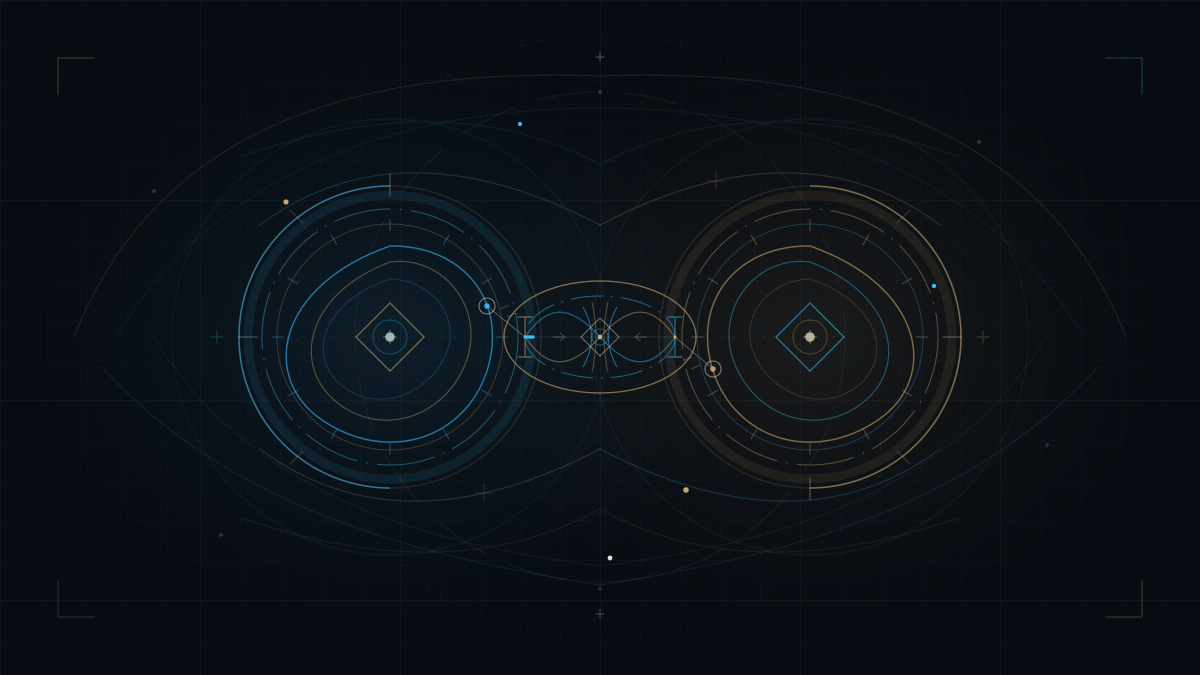
【Figure: Single-oscillator schematic—earthly branches as spring stiffness and connection conditions, heavenly stems as displacement output, luck cycles as external drive】
II. The Coupling Term: Rooting and Stem Penetration Are Two Directions of One Interface
Marriage connects a spring between the two oscillators. The coupling stiffness is denoted k_c; it need not be symmetric, and k_{AB}\neq k_{BA} is the norm rather than the exception.
m\ddot{x}_A + c_A\dot{x}_A + k_Ax_A = k_c(x_B-x_A) + F_A(t)Seen from A's heavenly stems, A draws stiffness from B's earthly branches, which the original calls rooting; seen from A's earthly branches, B's heavenly stems draw A's stored energy out into visible displacement, which the original calls stem penetration. The original's judgment is that rooting and stem penetration are not two separate mechanisms but two directions of observation on the same interface; put into an equation, they are readings of the same coupling term in two projections.
Directionality produces the first structural difference. One-way rooting, k_{AB}\neq k_{BA}, is directed coupling: energy flows mainly from one side to the other, one oscillator's phase is pulled toward the other's while the other barely moves. The original describes this as "one party is more likely to benefit in the relationship, the other more like the soil that provides," and lists attachment, lodging, and one-way fulfillment as its forms. In engineering this is called non-reciprocal coupling. It does not automatically equal instability, but it concentrates the effective damping on one side—on the supplying side, the real burden on c is rising.
Two-way rooting plus two-way stem penetration is symmetric coupling with both channels open, which the original calls the fullest form of the community. The benefit here is concrete: the coupling matrix is symmetric, energy can flow both ways, and the system therefore possesses a well-defined center-of-mass mode, namely the common mode discussed in Section IV.
This also shows, in passing, why the "favorable-element matching method" is imprecise. It compares the frequency labels of the two oscillators (their five-element attributes) and ignores the sign of the coupling term, the location of the channels, and the distribution of damping. Two oscillators with close frequencies may fail to lock entirely; two oscillators with a frequency offset can, when the coupling is strong enough, lock in phase stably. The original says this method's "theoretical basis is in fact not wrong"; the error lies in losing detail—precisely the direction of k_c and the distribution of c.
The original strictly confines favorable and unfavorable elements to the functional level and does not read them as five-element labels; this has an exact counterpart in dynamics: what makes the structure steadier, gives the role support, and keeps resources usable raises effective stiffness, lowers dissipation, and keeps channels open; the reverse lets stiffness fail, dissipation grow, and channels be bypassed. The object of judgment is parameters, not labels.
【Figure: Two oscillators coupled through a spring, with two arrows marking the drawing of stiffness (rooting) and the extraction of stored energy (stem penetration), respectively】
III. Phase Locking: Synchronization Only Within the Bandwidth
Let the phases of the two oscillators be \varphi_A and \varphi_B, with phase difference \varphi=\varphi_A-\varphi_B; its evolution is given by a standard equation:
\frac{d\varphi}{dt} = \Delta\omega - K\sin\varphi\Delta\omega is the detuning, that is, the difference between the two intrinsic rhythms; K is proportional to the coupling stiffness and to the amplitudes on both sides. The steady-state solution is \varphi^*=\arcsin(\Delta\omega/K), and its existence condition is K>|\Delta\omega|. This is precisely the phase-locking bandwidth: the coupling must be strong enough to overwhelm the detuning before the phase difference settles at some fixed value instead of drifting indefinitely.
When the bandwidth is insufficient, \varphi drifts monotonically and the system enters beating. In reality this does not look like "the relationship breaking down" but like rhythmic tugging: for a stretch the two are aligned, for a stretch they are not, and then they return again and again to the same point of misalignment. This is detuning, not a verdict.
But phase locking is not better the stronger it is. When K is too large, \varphi^* is pressed toward zero, the two oscillators become almost exactly in phase, the differential mode is crushed, and the community retains only one degree of freedom. The original puts it directly: coupling is not better the stronger it is; strong coupling can bring stability, and it can also bring bondage, dependence, and depletion. The dynamical price is fault tolerance—when the whole structure is rigidly joined together, any change in k or c on one side drags the other side along with it, with no buffer in between.
The complete condition for long-term stability is therefore threefold: a phase-locking solution exists; its basin of attraction is large enough; and the damping ratio is not too low. The basin of attraction is the range within which the phase difference, once pushed out, can still be pulled back. The original defines long-term stability as "the capacity of the community structure to maintain a shared resource pool and mutual role fulfillment under the perturbations of the luck cycles"—this is exactly the language of the basin of attraction: not the absence of perturbation, but the ability to come back after it.
There is a further layer: k, c, and \Delta\omega all drift with the luck cycles. When the decade luck changes qi, the parameters undergo a step change, and a phase difference that lay inside the bandwidth may be pushed out of the locking region—and the reverse can happen as well. Phase locking is therefore not a state attained once and for all, but a solution that must be reconfirmed in every parameter interval.
The state of the supporting branch is the parametric modulation of the coupling term. When combination strengthens, k_c increases and keeps its sign, and the support is expanded. When combination alters the nature, k_c changes sign and the original restoring force becomes a repulsion; the original says "what was support later becomes depletion," and sign reversal is exactly what that means. When combination binds, a large damping is inserted in series in the channel; k_c is still there, but transfer efficiency is low, manifesting as wanting to help yet being unable to.
Clash and punishment-harm are another kind of modulation. A clash is an instantaneous, large-amplitude modulation of the parameters, an abrupt jump in amplitude; if what is clashed is precisely a key supporting branch, that channel's k_c goes directly to zero. Punishment and harm do not sever the channel; they are only a slow leakage of damping, and the cost of maintenance keeps rising.
IV. Common Mode and Differential Mode: Four Coupling Channels
Two symmetrically coupled oscillators have two eigenmodes.
The common mode is in-phase motion: the two oscillators move together, their responses to the external drive add, and the frequency is essentially unchanged. It is the dynamical entity of the "we" level—when the luck cycles arrive, the two are pushed in the same direction.
The differential mode is anti-phase motion: the two oscillators move relative to each other, and the stiffness is raised (under symmetric coupling, to k+2k_c); it is therefore not directly excited by the external drive, but only by internal detuning and coupling asymmetry. It is the relative displacement that "I" and "you" each still retain.
The dynamical condition for mutual role fulfillment can be stated very hard: the differential mode must not be crushed to zero. As the differential-mode amplitude tends to zero, the individual has no relative displacement within the community, and there is no "because of you, I become more myself"—only "I have been merged into us." The original sets an inalienable limit here: resource sharing must not come at the price of canceling the individual. Translated, coupling must not degrade the differential mode.
The two North Star metrics can therefore be written separately. Long-term stability corresponds to a bounded common mode and a phase-locking basin of attraction; mutual fulfillment corresponds to the differential mode retaining amplitude, with each oscillator's effective amplitude after coupling no lower than before. These two conditions do not point the same way: raising K helps the former and harms the latter. This is why "the tighter the binding, the better" is wrong.
The palace position determines which segment of the structure the coupling attaches to, and hence which frequency band it acts on.
The year pillar is the background resource layer, the parents' palace, corresponding to the early years and to ascribed conditions. Here the coupling has large inertia and changes slowly, a low-frequency channel: it makes the system steadier against slow perturbations, but does not necessarily give support to everyday high-frequency interaction. The original's risk statement matches: family and background ties are very strong, while daily intimacy need not be deep.
The month pillar is the social resource layer, the career palace, corresponding to the daily order and the external rhythm. The month command is the guiding principle, the strongest in energy; this coupling path directly rewrites the two oscillators' operating frequency, which is why the original says "career is strongly bound, while emotional life is not necessarily settled."
The day pillar is the intimacy resource layer, the spouse palace. This coupling path has the shortest distance, is most sensitive to the phase difference, and perturbations reach the core directly. The original's judgment is worth noting: the day branch's energy is less than the month command's, yet for those who seek intimacy it is the most sensitive and the most critical. Short-range coupling does not need the greatest stiffness; it has the highest signal-to-noise ratio.
The original also notes that when an annual clash strikes the day branch, what is shaken first is the core community layer; if that day branch is at the same time a key supporting branch, it constitutes a critical severing of the root. In the language of coupling, that is k_c on the shortest-range channel being driven directly to zero.
The hour pillar is the outcome resource layer, the children palace, corresponding to long-term output and to later life. This channel has a large time constant: weak response early, significant accumulation later. The original says "not necessarily marked in youth, but the more it goes on, the steadier it becomes," which is exactly the signature of a slow channel.
The four channels stand side by side, but they are not four scoring items. They differ in bandwidth and in time constant; choosing a partner type is in substance choosing on which channel to establish the main coupling. The original's sentence "the palace positions can help the native find the desired partner type" means exactly this in dynamical terms.
【Figure: The four coupling channels arranged by frequency band—year pillar low frequency, month pillar main frequency, day pillar short range, hour pillar slow time constant】
Back to the dance floor. Two dancers cannot synchronize by eliminating their own inertia; they can only transmit enough force through the contact surface to press the phase difference into the bandwidth, while each keeps their own axis. Press too hard and the two fall together.
Marriage matching is therefore not a judgment of "compatible or not," but an estimate of three structural quantities: the detuning \Delta\omega, how far apart the two intrinsic rhythms are; the coupling K, how much force the cross-chart interface can transmit; the damping c, what it costs to maintain that channel. All three are rewritten by the luck cycles, so every conclusion carries an expiry; there is no one-time verdict.
This is the limit of what the model can account for: it describes structure, it does not promise outcomes.
Compiled by Qiushui Guanxiang Studio