

A Tendency Is Not a Verdict
You've seen your chart. Maybe you ran a free calculator once, late at night, and ended up staring at a page of element counts and short notes. You got curious — about your own leanings — but you didn't come here for promises.
Good. Hold on to that skepticism. It makes everything below more useful, not less.
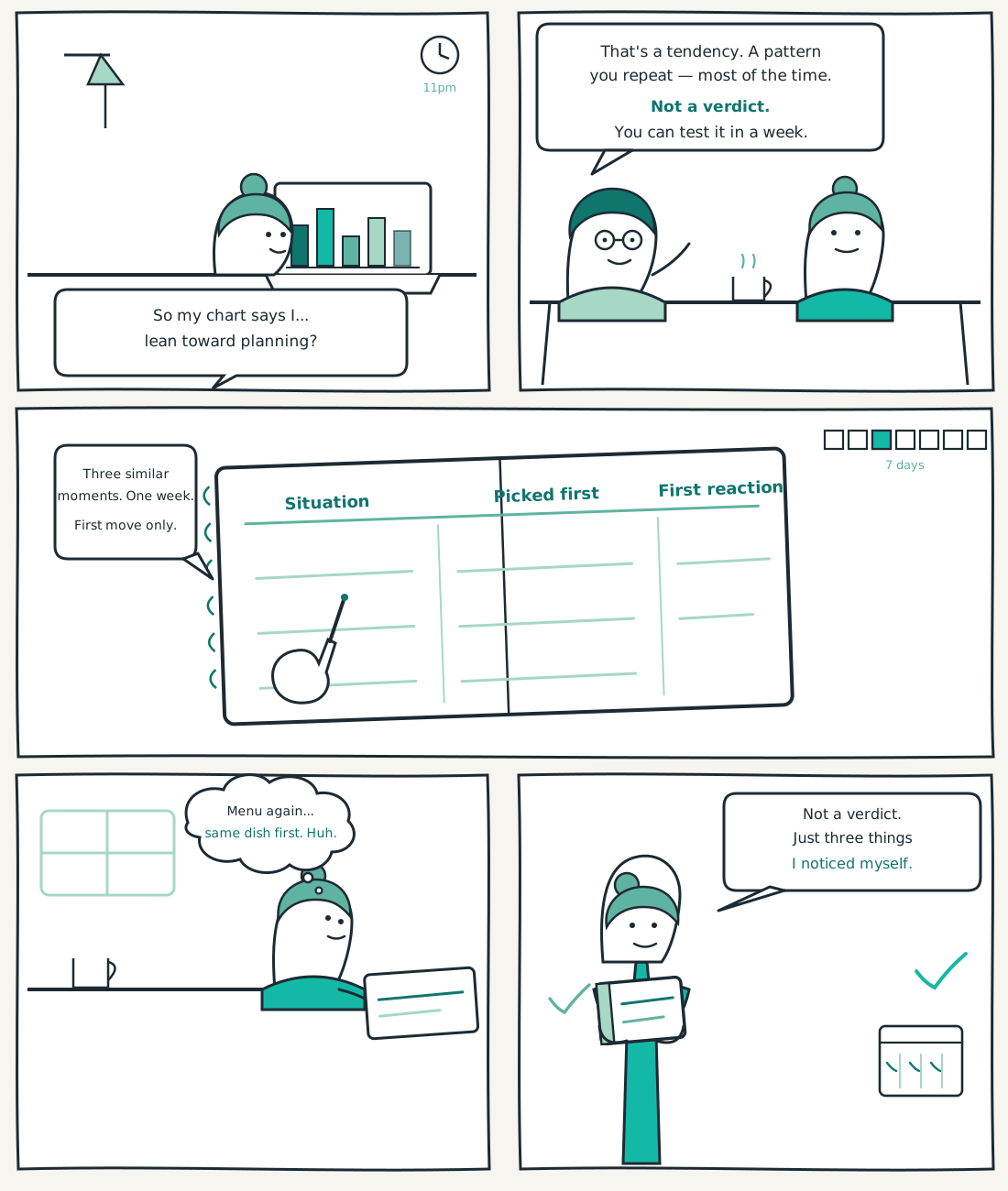
This whole post comes down to one move: read a tendency as a pattern you can notice and test within a week. Not as a verdict on who you are. Not as a forecast of what's coming.
What a tendency actually is
A tendency is a lean. A drift. The thing you do first when nobody has asked you to be careful.
Maybe you read the entire menu and then order the same dish anyway. Maybe you rehearse a hard conversation nine times and then improvise the whole thing. Maybe you say yes fast and feel it an hour later. Those are patterns — visible, repeatable, testable.
A pattern is not a prophecy. It usually just means that under similar pressure, you tend to land in a similar spot. Most of the time. Not always. That's the entire claim, and it's enough to work with.
The real trap isn't having a tendency — everyone has them. It's when a label hardens into a sentence. "I'm just like this." And once that sentence sets, you stop checking whether it's even true this week.
The one-week observation table
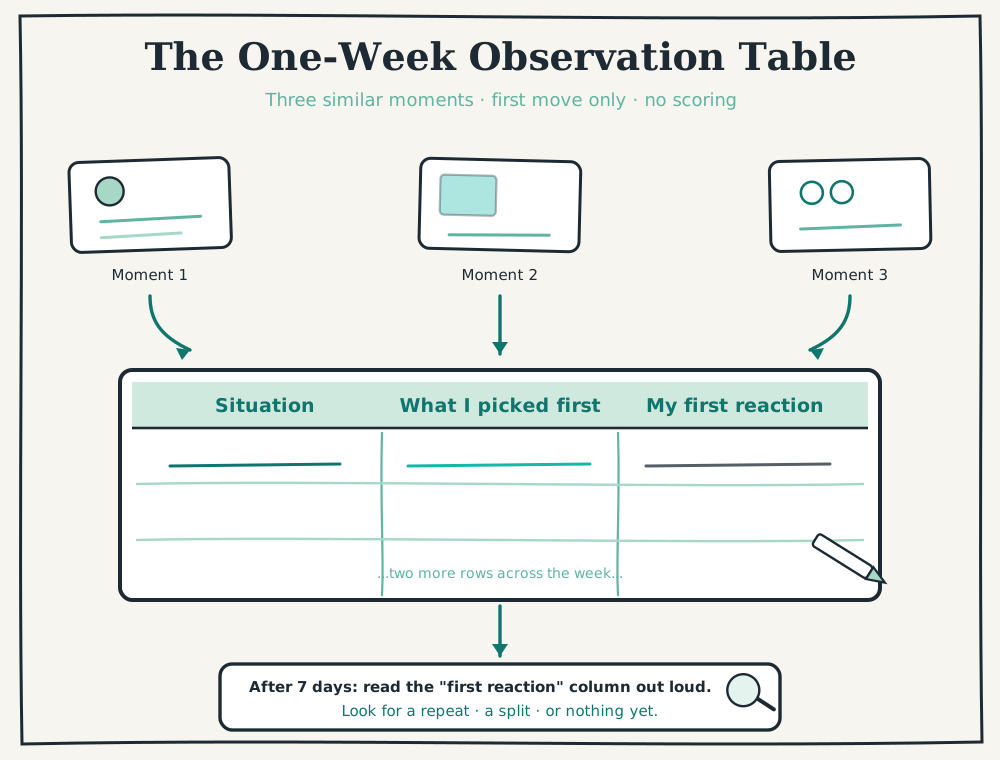
Here's the small experiment. Each entry takes about ten seconds, and you need three of them across one week.
Grab any notebook or note app and make three columns:
| Situation | What I picked first | My first reaction |
|---|---|---|
| Dinner with friends, menu arrives | ||
| A plan changes at the last minute | ||
| Someone asks me for a favor |
Then, the next three times you land in a similar spot, fill in one row. Not your final decision — your first one. The first thing your hand reached for. The first sentence that formed in your head. Write it down before your inner lawyer gets a chance to edit.
That's it. Three rows in seven days.
Why first reactions? Because that's where a tendency shows itself most clearly. By the time you've reasoned your way to a choice, several patterns have already voted. The first pick is the raw data. The reasoning is the commentary.
And you're not scoring yourself. You're not grading the chart against your behavior, or your behavior against the chart. You're collecting three data points of your own — that's all.
What the table can and can't tell you
After a week, look at the "My first reaction" column and read it out loud. Most people land on one of three things:
- A repeat. The same first move, three times, in three different outfits. That's a real tendency — and now you get to decide, consciously, whether to keep it or work around it.
- A split. Two rows match and one doesn't. That usually means the situation matters as much as the tendency. Pressure, people, and time of day all bend your first move a little.
- Nothing yet. Three rows, no pattern. That's fine. It usually means the situations weren't as similar as they looked, or you were watching yourself too closely. Run another week with closer-matched moments.
Notice what the table didn't do. It didn't predict your year. It didn't tell you who to marry or which job to take. It handed you something better than a prediction: something you can actually check.
This is also where decision journaling earns its keep. If you already jot down the choices you make and why, your three rows slide in right next to those notes. Over time, first reactions and written reasons sitting side by side show you where your instincts are reliable and where they're just loud. If you want a structured way to do that, our guide to decision journaling walks through the setup in plain terms.
And for the days when your gut and your notes disagree, it helps to know which one to listen to. How to trust your gut is about exactly that boundary — when a fast read is experience talking, and when it's only noise.
The point of noticing
None of this is about fixing yourself. A tendency you can see isn't a flaw; it's a default setting. Defaults are useful — they save energy. They only become a problem when you forget they're defaults and start treating them like law.
Most of the time, the people who get the most out of reading about their own patterns aren't the ones who believe the most. They're the ones who check the most. Curious, skeptical, willing to run a small experiment before drawing a big conclusion.
That combination — curiosity without credulity — is the whole tool.
Do this today
Pick one recurring moment in your day. Just one. The menu, the inbox, the group chat, the morning plan. Tonight, write down what you reached for first, and what your first reaction was.
One line. One day. That's the whole assignment.
If it's still interesting by Friday, add two more lines. If it isn't, you spent ten seconds — and you learned that too, which is also worth knowing.
Join TangoEra on Telegram — daily timing notes and new releases