

Five elements as a vocabulary, not a forecast
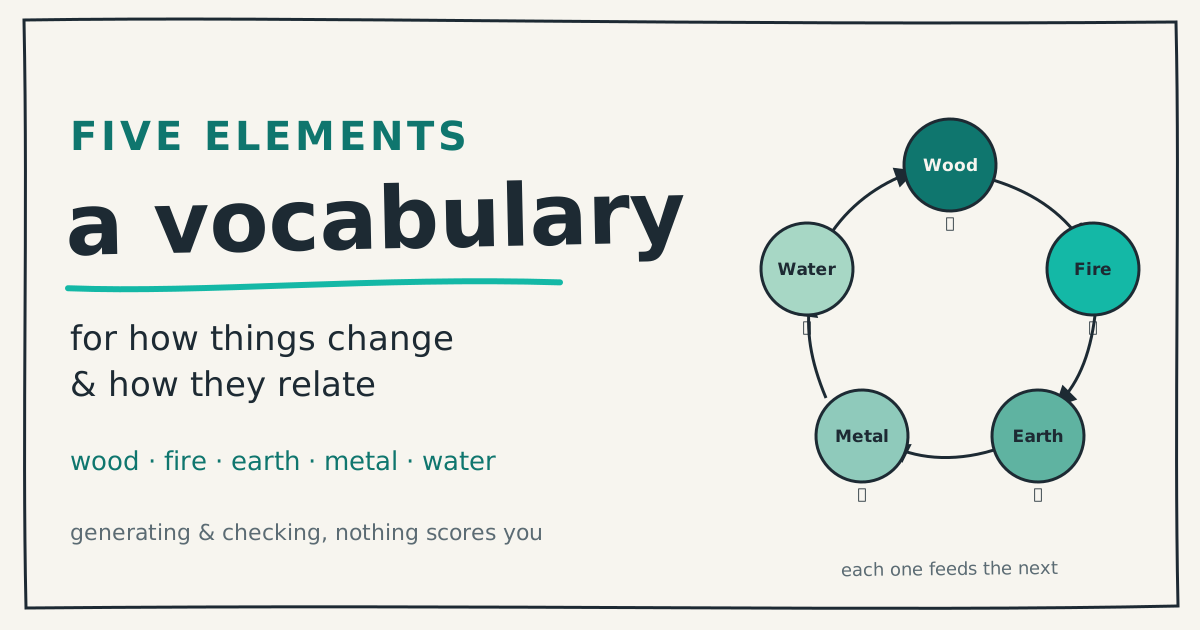
If you hang around Chinese philosophy for more than five minutes, you will meet the five elements: wood, fire, earth, metal, water. They show up in cooking, medicine, calendars, garden design, and a thousand proverbs. But here is the thing most introductions get wrong: the five elements are not a personality quiz. They are not a scoring system, and they are not a prediction machine. They are something more useful and more modest — a vocabulary. A set of words for talking about how things change and how things relate to each other.
Think of them less like test results and more like the words "hot" and "cold" in weather talk. Nobody asks whether your day is morally better for being cold. Cold is just a word that helps you describe what is happening.
The two relationships that run everything
The whole system rests on two verbs: generating (sometimes called nurturing) and restraining (sometimes called checking). Every relationship between the elements is one of these two.
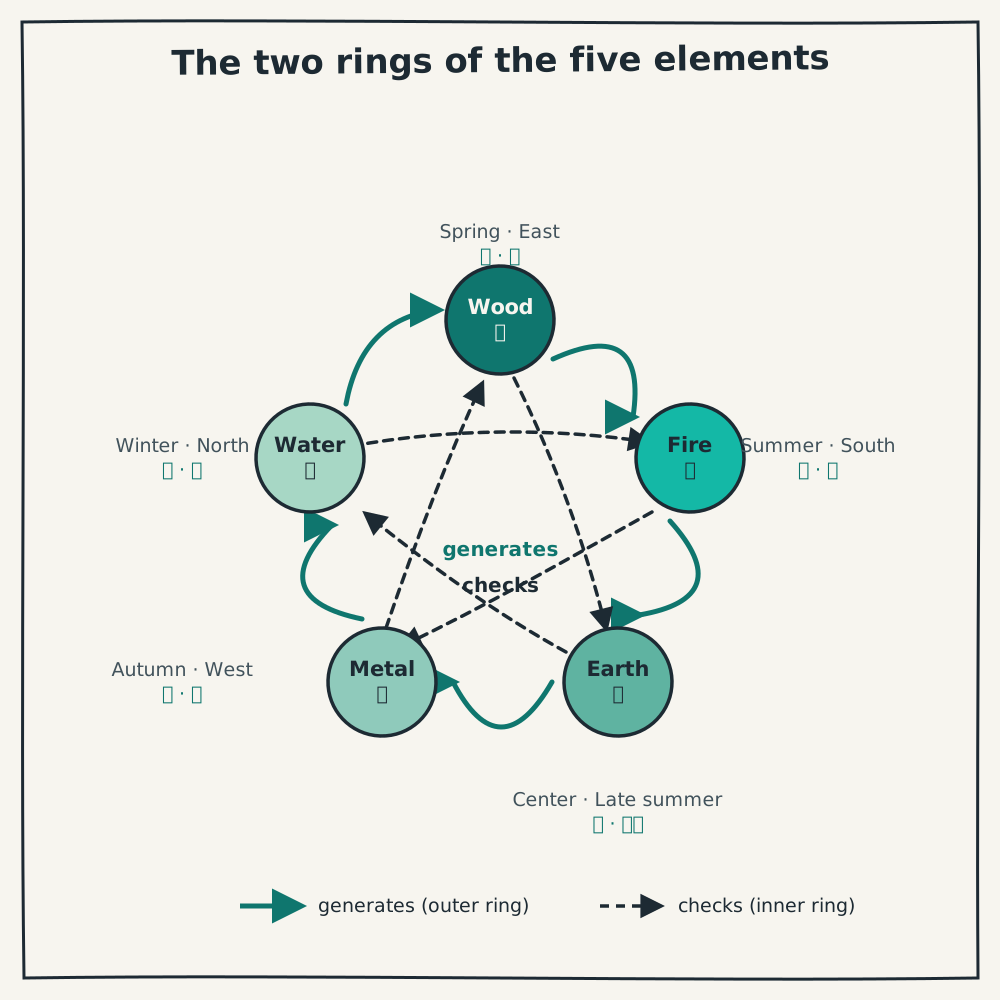
Generating is the easy one. Wood generates fire — picture a dry branch catching and feeding a campfire. Fire generates earth — a log burns down and what is left behind is ash, which becomes part of the ground. Earth generates metal — metals are dug out of, and refined from, the ground itself. Metal generates water — one traditional image is the condensation that beads on a cold metal cup on a humid day. Water generates wood — a tree drinks water and slowly turns it into growth.
The generating cycle runs in a ring: wood feeds fire, fire leaves earth, earth holds metal, metal gathers water, water grows wood. Nothing is the beginning and nothing is the end. Each element is both a beneficiary and a supporter, which is a quietly interesting way to think about almost anything.
Why the restraining cycle matters too
The second relationship, restraining, is the one people tend to skip, and it is arguably the more interesting half. Restraining is not destroying. It is keeping in check, the way a fence keeps a garden useful.
The checking ring also runs in a neat loop: wood checks earth (tree roots hold soil in place and stop it washing away), earth checks water (a dam or an embankment shapes and limits a river), water checks fire (a bucket on a kitchen flame, about the most basic fire drill there is), fire checks metal (heat softens and reshapes a blade), and metal checks wood (an axe, a pruning shear, a carpenter's chisel all give wood a boundary).
Notice what is happening here. Nothing wins. Fire beats metal, sure, but metal beats wood, wood beats earth, and earth beats water — which in turn beats fire. The system is balanced not because everything is equal, but because every strength has a counterweight somewhere else in the ring. That is a remarkably sturdy idea, and you do not need to believe anything mystical to find it useful.
The seasonal and directional map
In the Chinese tradition, the elements are also tied to the calendar and the compass, and these pairings are standard, textbook-level material. Wood sits with spring and the east — the season and direction of things sprouting. Fire sits with summer and the south — peak warmth, longest days. Earth sits at the center, and is also associated with the "long summer," the humid late-summer stretch when everything ripens. Metal sits with autumn and the west — the season of harvesting, cutting, and gathering in. Water sits with winter and the north — the season of stillness and storage.
You will sometimes also see traditional color pairings: green or azure for wood, red for fire, yellow for earth, white for metal, and black or deep blue for water. We mention this only as cultural background — like knowing that a bride might wear white in one country and red in another. It is context, not a rulebook for your wardrobe.
What this vocabulary is for
Here is the stance we want to leave you with: the five elements are a language for describing relationships, not a tool for grading people. It doesn't score you, rank you, or tell your future.
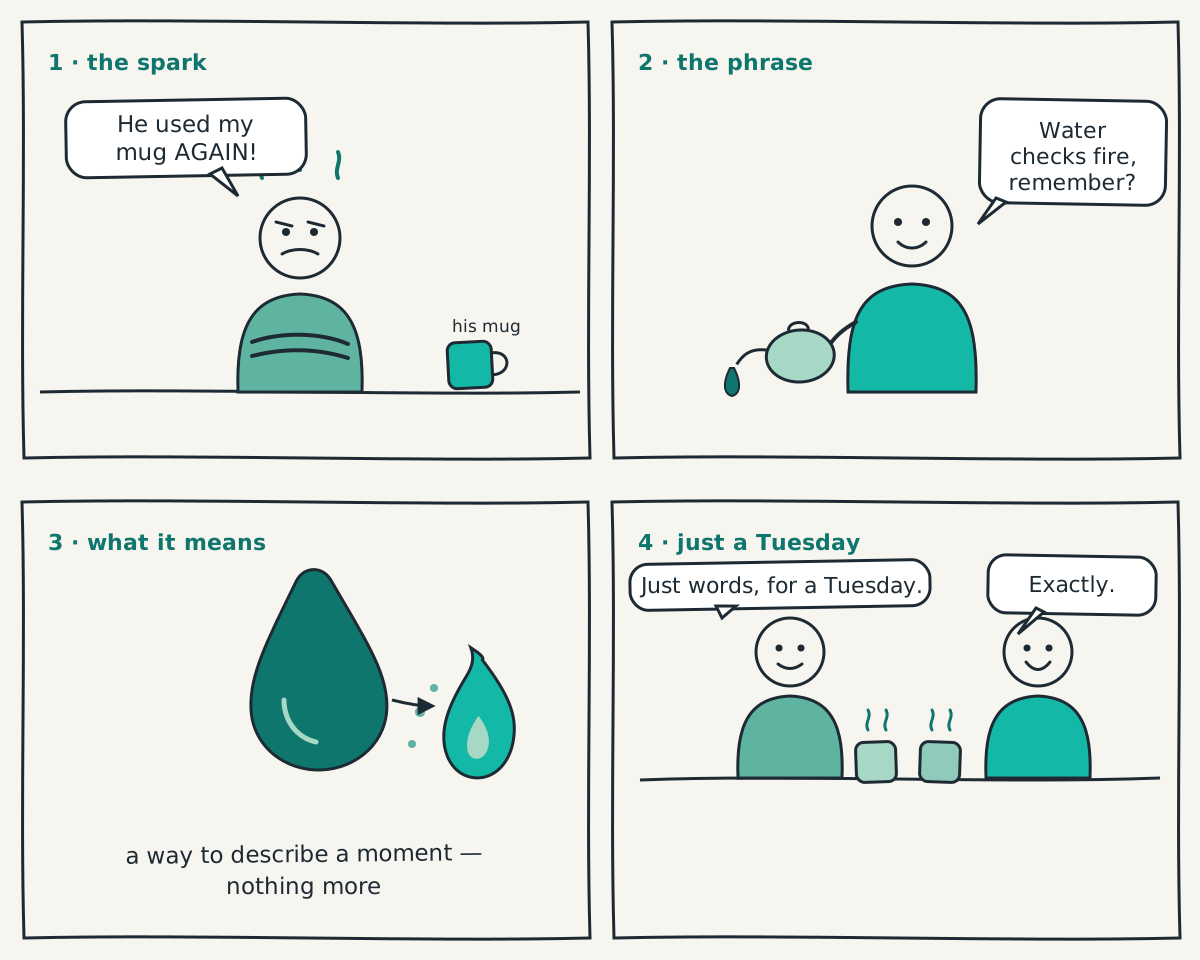
Used well, the vocabulary is generous to ordinary life. Imagine someone whose temper flares easily, and someone else whose calm is nearly unshakable. You could describe that second person, in this vocabulary, as "water checking fire" — their steadiness keeps the first person's heat from spreading. That is a real, human, observable dynamic. It is not a claim about anyone's fate. It is a sentence about how two people interact, on a particular Tuesday.
Compare that with reading the elements as a verdict, as if a person could be "missing" an element and had arrived damaged from the factory. The traditional material is far more interesting when you read it as description rather than diagnosis. The elements describe processes — sprouting, burning, ripening, harvesting, storing — and processes are things we can all watch, name, and talk about.
A small experiment for this week
If any of this sounds like it might be fun rather than forbidding, here is a one-sentence exercise you can do today. Pick two things that happened to you this week — anything: a deadline, a long walk, an argument, a good meal — and describe how they relate using just two words from this vocabulary: generates or checks.
Maybe the long walk generated the good mood that made the deadline survivable. Maybe the argument checked your enthusiasm for a plan. One honest sentence is enough. You are not predicting anything, and nobody is keeping score. You are just trying on a very old pair of descriptive glasses — and seeing whether the world looks any sharper through them.
Join TangoEra on Telegram — daily timing notes and new releases