

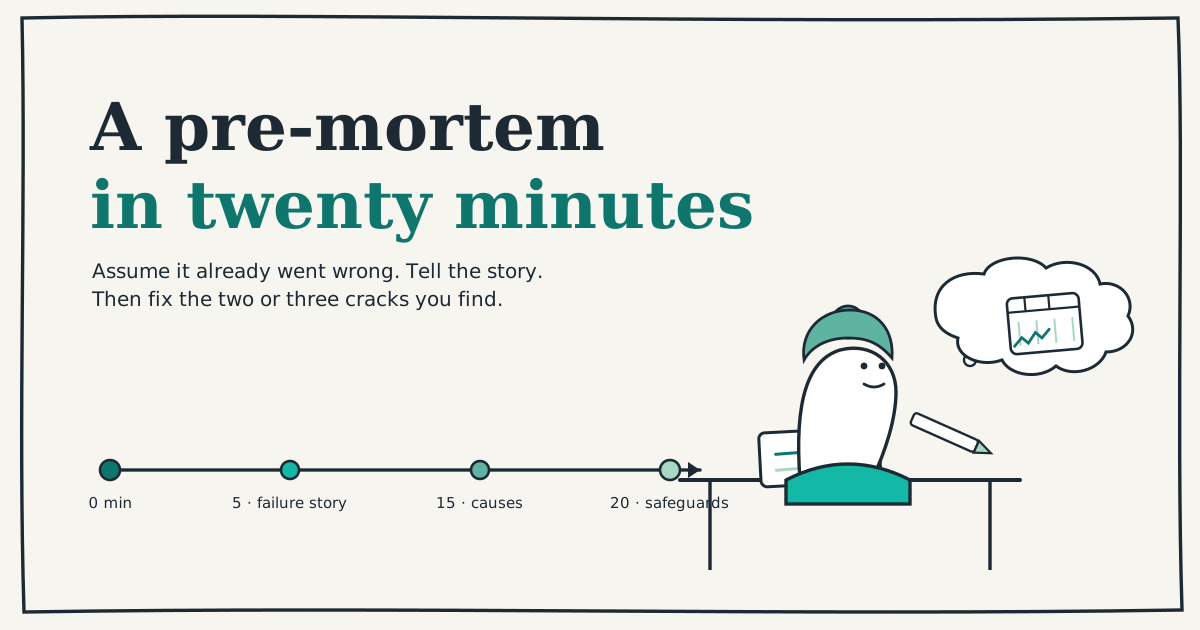
A pre-mortem in twenty minutes
You've made the decision. Or you're about to. Quit the job. Launch the thing. Move to the smaller city. And everyone you've told says it sounds great, and you want to believe them, and somewhere in the back of your head a small voice keeps clearing its throat.
This post is for that voice.
It's about a simple move, usually credited to the psychologist Gary Klein: before you commit, assume it already went wrong. Not vaguely wrong — specifically, concretely, embarrassingly wrong. It's six months from now and the thing failed. Now tell the story of how. Work backwards from the wreckage, and you'll usually spot two or three things you can fix before you ever start.
Klein called it a pre-mortem. You don't need a project room — just a kitchen table, a friend or a notebook, and twenty minutes.
Here's the whole process.
Minutes 0–5: write the failure story
Set a timer. Seriously — the timer is what makes this twenty minutes instead of an evening.
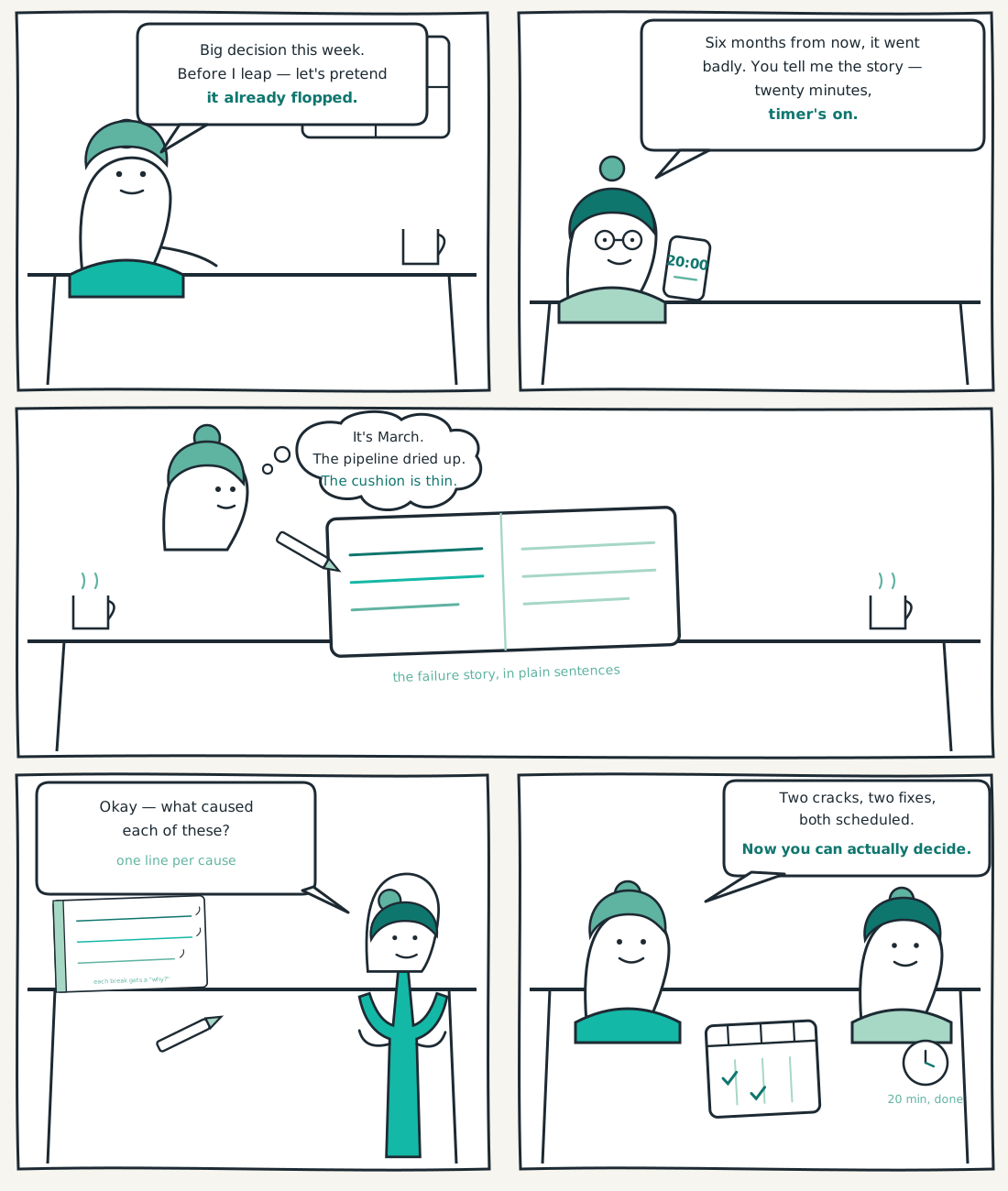
Now write, in plain sentences, what the failure looks like. Past tense. Specific. Not "it didn't work out" but "it's March, the launch flopped, I burned through my savings cushion, and I'm rewriting my resume at midnight wondering what I was thinking."
Say someone is deciding whether to leave a steady job for a freelance practice. Their five-minute story might be: six months in, the pipeline dried up, the confidence that felt like a plan turned out not to be one, and the savings that felt generous turned out to be thin. Each of those is a candidate cause. Which brings us to the next block.
If you get stuck, use this prompt: "It's six months later and this went badly. I'm telling a friend what happened." Write the conversation.
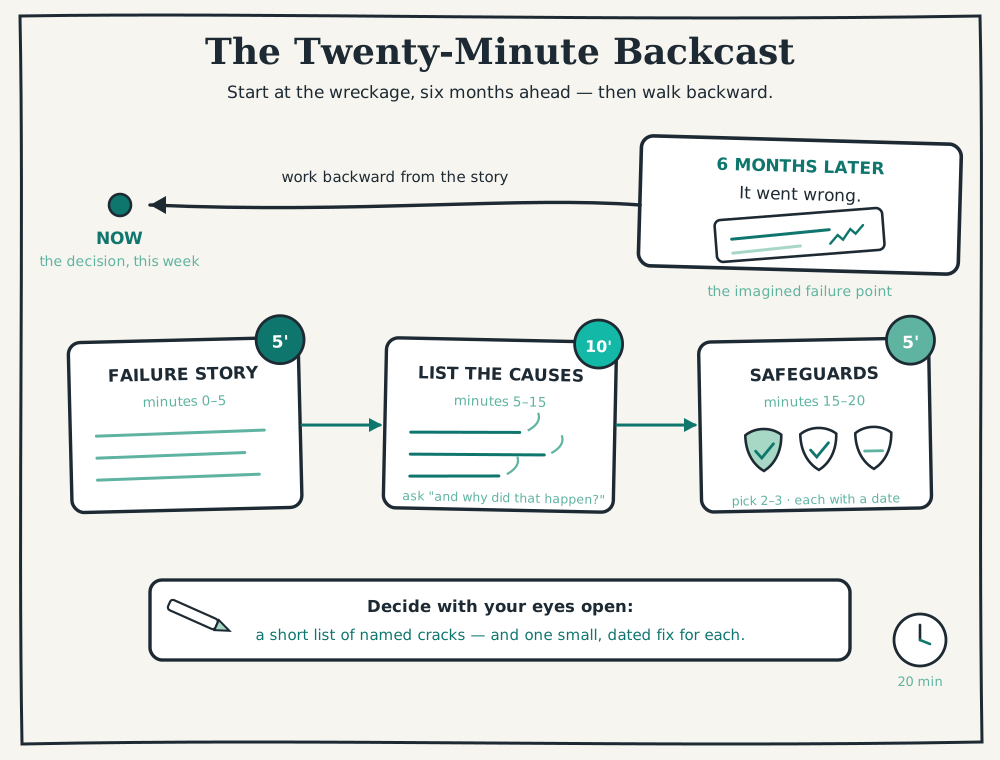
Minutes 5–15: list the causes
Now read your failure story and underline every moment where something broke. For each break, ask: what caused this? And keep asking one level deeper, at least once or twice.
You're not listing everything that could go wrong in the universe. You're listing the things that, in your story, actually went wrong. That constraint matters. "A meteor hits the office" is not in your story. "I assumed my old boss would send referrals and she got busy" probably is.
Write the causes down as plain statements, one per line:
- I assumed referrals would keep coming on their own.
- My savings covered six months of my old budget, not my new one with self-paid insurance.
- I hadn't tested whether I could stand pitching strangers, and it turned out I hated it.
Ten minutes, as many causes as the story hands you. Aim for at least five. If the list stalls, ask "and why did that happen?" about the last one.
Notice you're not judging the decision yet. You're mapping where it could crack. Some people find their failure story was pure fog — the exercise cost them ten minutes and some vague dread, a fine trade. Others find the crack sitting in step one, and just saved themselves a very educational mistake.
Minutes 15–20: pick your safeguards
You can't pre-fix everything on that list, and you shouldn't try. Pick the two or three causes that seem most likely and most preventable, and attach one concrete safeguard to each.
A safeguard is a small action you can schedule this week, not a vow. Compare:
- Vow: "I will network harder." (Meaningless. You'll forget by Thursday.)
-
Safeguard: "Before I hand in notice, I'll book three conversations with people who hire freelancers, and ask them directly where their work comes from."
-
Vow: "I'll be more careful with money."
- Safeguard: "I'll redo the budget with insurance and taxes in it, and require the savings to cover nine of those months, not six."
The shape is nearly the same every time: cause → one checkable action → a date it happens. If a safeguard has no date, it isn't a safeguard yet; it's a wish.
Then stop. The timer rings, you close the notebook, and you make your call however you were going to make it — gut, spreadsheet, coin flip. The pre-mortem doesn't make the decision. It just makes sure you decide with your eyes open about the three places it could actually break.
Why this works when ordinary worry doesn't
Ordinary worry is a fog that hangs over the whole future. It doesn't tell you where to step; it just makes everything dim. A pre-mortem is different: it gives worry a job. Instead of hovering, it produces a short list of named cracks and a matching set of small, scheduled patches.
And because the whole thing is framed as a story — say someone whose plan broke this way — it stays honest. You're not predicting. You're rehearsing. It's a bit like a player rehearsing the missed shot as well as the good one: a drill, not a forecast.
There's also a quiet side effect. The failure story you write in minute three is rarely the failure you actually hit, if anything fails at all. But the kind of causes — assumptions, untested comforts, budgets with missing lines — repeats across decisions. Do three or four pre-mortems and you'll start to recognize your personal greatest hits: your own pattern, gathered from your own stories, checkable any time.
Do this today
You don't need a big decision waiting. Take the medium one — the one you've been circling for a week. Set a five-minute timer and write the sheepish conversation: it's six months later, it went badly, you're explaining why.
Five minutes. One story. If it surfaces nothing, you've lost five minutes and gained some fog lifted. If it surfaces something, you now have a name for the crack — and named cracks are far easier to fix than free-floating dread.
That's the whole assignment. The timer's right there.
Join TangoEra on Telegram — daily timing notes and new releases