

Reversible or one-way: sort the decision first
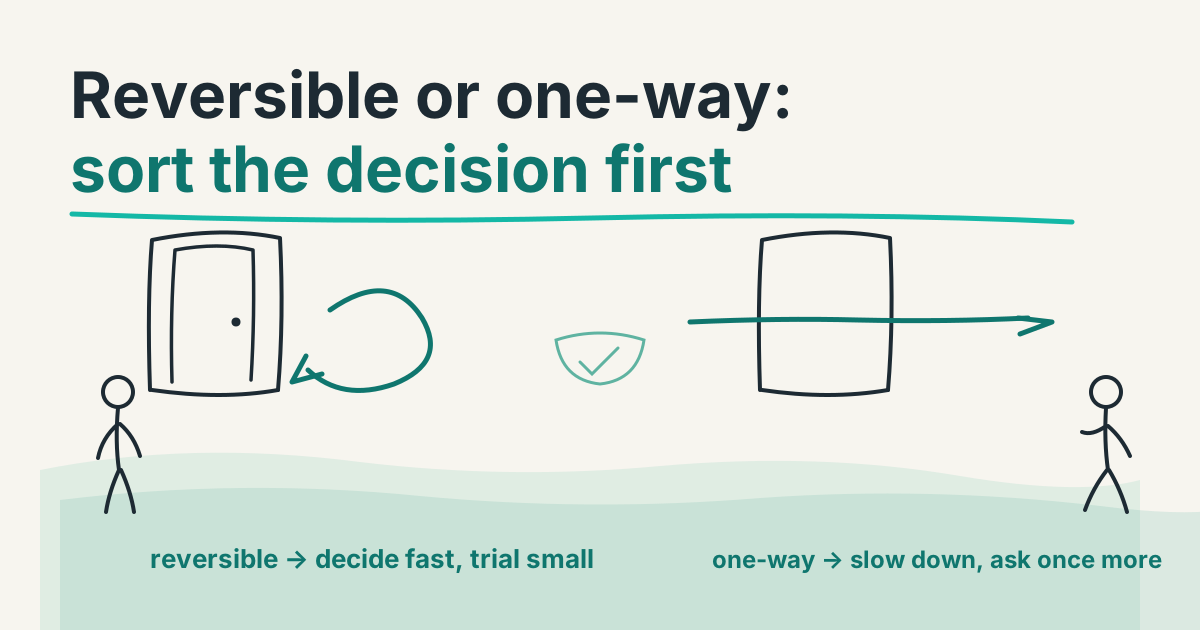
Some decisions are like trying a new coffee order. If you don't like it, you toss it or order something else tomorrow. Others are more like getting a big piece of ink on your skin — you can work around it later, but you can't go back to exactly how things were.
Most of us treat every decision the same way: same amount of worry, same amount of waiting, same late-night spiral. But the two kinds don't deserve the same treatment. Before you weigh pros and cons, before you poll three group chats, there's a smaller question worth answering first:
Can I undo this easily, or not?
The two buckets
Call them what you want. Here we'll use "reversible" and "one-way."
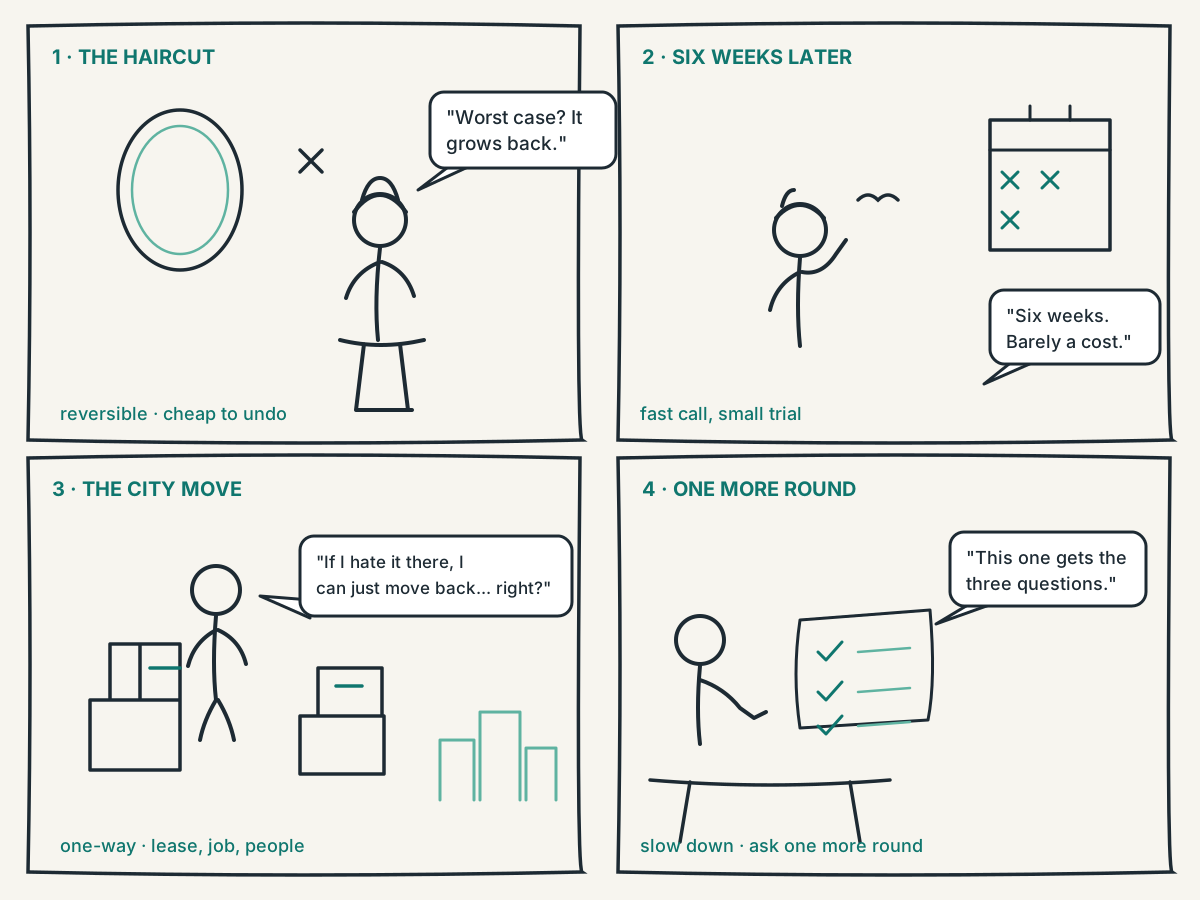
A reversible decision is one where a wrong call costs you some time and maybe some money, and then you can walk it back. Changing your mind about a haircut. Trying a new morning routine for a week. Switching to-do apps. Sending the imperfect draft instead of sitting on it for a month.
A one-way decision is one where walking back is hard, slow, expensive, or maybe not fully possible at all. Say someone quits a long-term job with nothing lined up. Maybe it works out beautifully — but going back to the old role, at the old terms, with the same trust, is not a switch you can flip. Moving countries. Co-signing a loan. Having a hard conversation in front of an audience instead of in private.
Neither bucket is "scary." They're just decisions with different physics. Reversible decisions are cheap to get wrong, so speed is your friend. One-way decisions are expensive to get wrong, so a little slowness is your friend.
Why sorting first helps
Here's what usually happens without the sort. A reversible decision — say, which template to use for a one-page site — gets two days of comparison charts. Meanwhile a one-way decision — say, whether to move in with a partner — gets settled in one rushed weekend because the lease deadline was looming.
That's backwards. Two days on a template that takes twenty minutes to redo. Twenty minutes of real thought on a living arrangement that could take months to untangle.
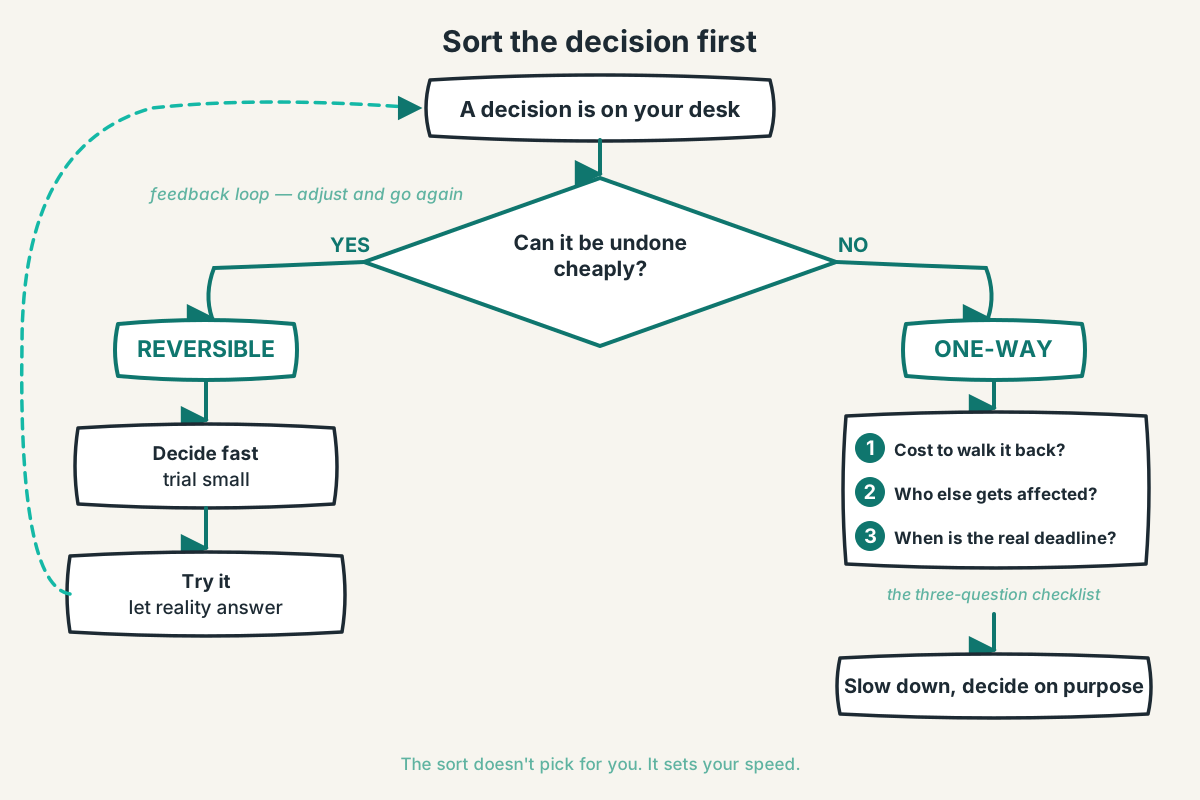
Once you sort the decision, the energy budget writes itself:
- Reversible → decide fast, trial small. Set a timer if it helps. Make the smaller version of the call and let reality give you feedback.
- One-way → slow down, ask one more round of questions. Talk to someone who made a similar move a few years ago. Sleep on it at least once past the deadline pressure.
The sort doesn't tell you what to choose. It tells you how much choosing is worth.
The three-question checklist
For anything that lands in the one-way bucket, run these three questions before deciding. Write the answers down — half a sentence each is plenty.
- What would it cost to walk this back? Time, money, relationships, options. Not the worst case — the realistic case. If the honest answer is "a few weeks and a bruised ego," maybe the decision was reversible after all. If the answer is "I couldn't really go back," you know what you're holding.
- Who else gets affected? Some decisions only rearrange your own week. Others touch a partner, kids, coworkers, a co-founder. The more people's plans lean on your call, the more their voices belong in your one extra round of questions.
- When is the real deadline? Not the loud one — the real one. Plenty of "urgent" deadlines turn out to be soft. Plenty of quiet ones — a lease that auto-renews, a visa window, a health thing you've been putting off — are firmer than they look. Knowing the true last moment lets you use the time before it on purpose, instead of spending it anxious.
Three questions, two minutes, one honest page. It won't make a hard call easy. It will keep you from making it at the wrong speed.
When you're not sure which bucket
A lot of decisions look one-way from far away and reversible up close, and vice versa. Say someone is offered a role at a new company. Leaving feels like a one-way door — but maybe the industry is small and paths cross again, so it's partly reversible. Say someone is choosing a college major. It feels like wet concrete — but plenty of people shift fields within a few years of graduating.
When the bucket itself is unclear, here's a simple tiebreaker: assume it's one-way, run the three questions, and watch what comes up. If the answers come back light — easy to undo, few people touched, plenty of time — congratulations, you just learned it's reversible, and you can speed up with a clear head. If they come back heavy, you were right to slow down.
Do this today
Pull up whatever decision is currently living in the back of your mind. The one you keep circling.
Write one line: reversible or one-way. Then act accordingly — set a ten-minute timer and just try the reversible one, or book twenty quiet minutes this week for the one-way one and draft your three answers.
One line, one small action. That's the whole assignment. And if you find you mislabeled the bucket, that's fine too — you just learned something about the decision you didn't know this morning, which is exactly the point of sorting it first.
Join TangoEra on Telegram — daily timing notes and new releases