

How to actually sleep on it
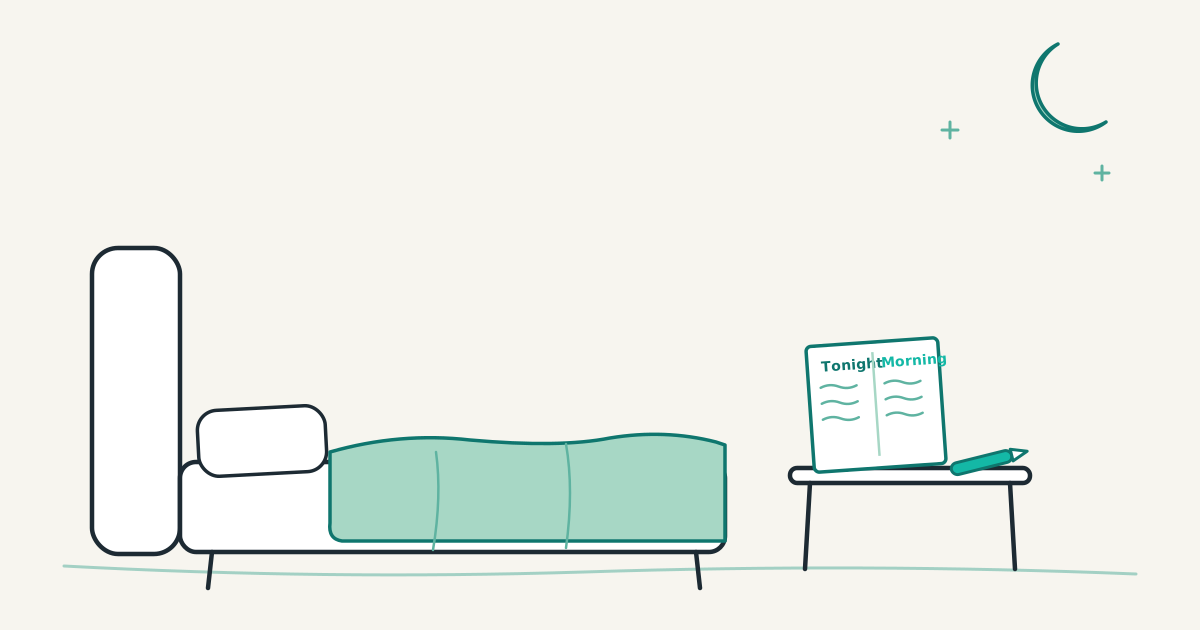
"Let me sleep on it" might be the most politely useless sentence in the English language. Most of the time, it means one of two things: I'm stalling because I don't want to decide, or I've already decided and I'm just delaying the moment I have to say it out loud. Either way, the sleeping part rarely does any work. You go to bed, you scroll, you wake up, and the problem is exactly where you left it.
This is just a habit — a way of organizing your thoughts so that a night actually does something for you. It takes about three minutes before bed and two in the morning. Here's how it works.
The night version
Before you go to sleep, get a piece of paper or a notes app. Then do three things.
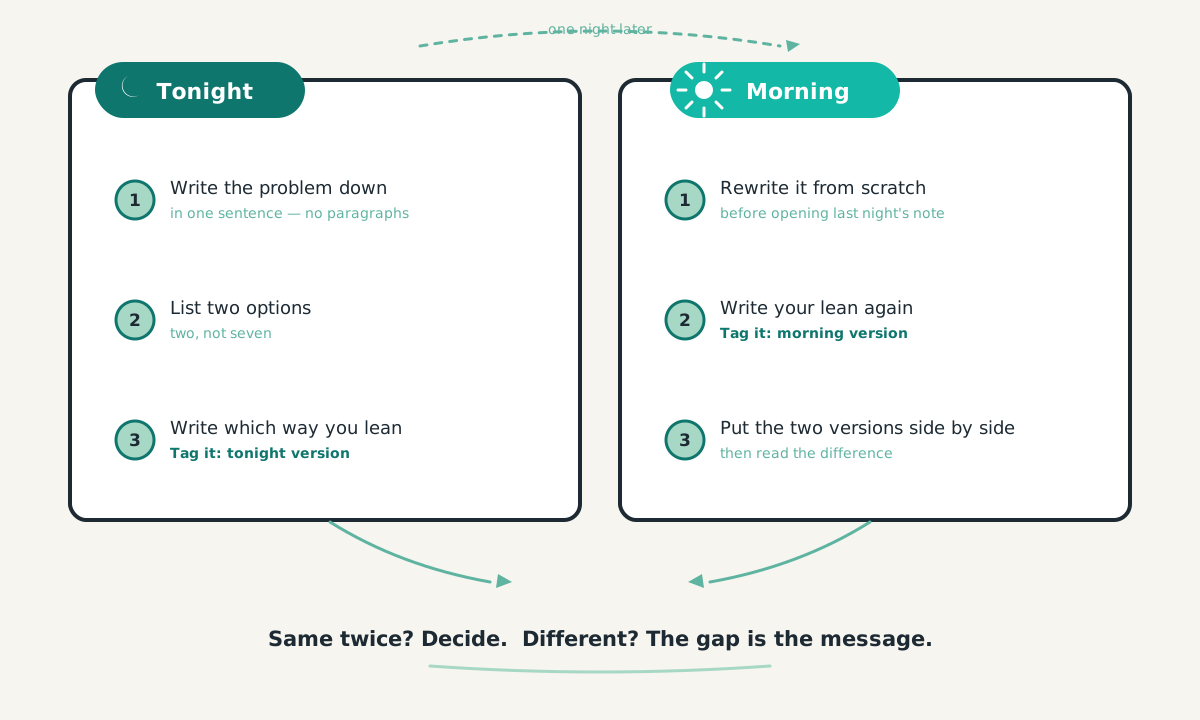
First, write the problem down in one sentence. Not a paragraph. One sentence, the way you'd explain it to a friend on the phone. If you can't squeeze it into one sentence, that's useful information by itself — it usually means you're actually worried about two or three different things at once, and it helps to know that.
Second, write down two options. Two, not seven. Even if one of them feels ridiculous, even if you already have a favorite. This matters because a decision that exists only in your head behaves like fog. Written down, with an alternative sitting right next to it, it behaves like an object — something you can actually look at.
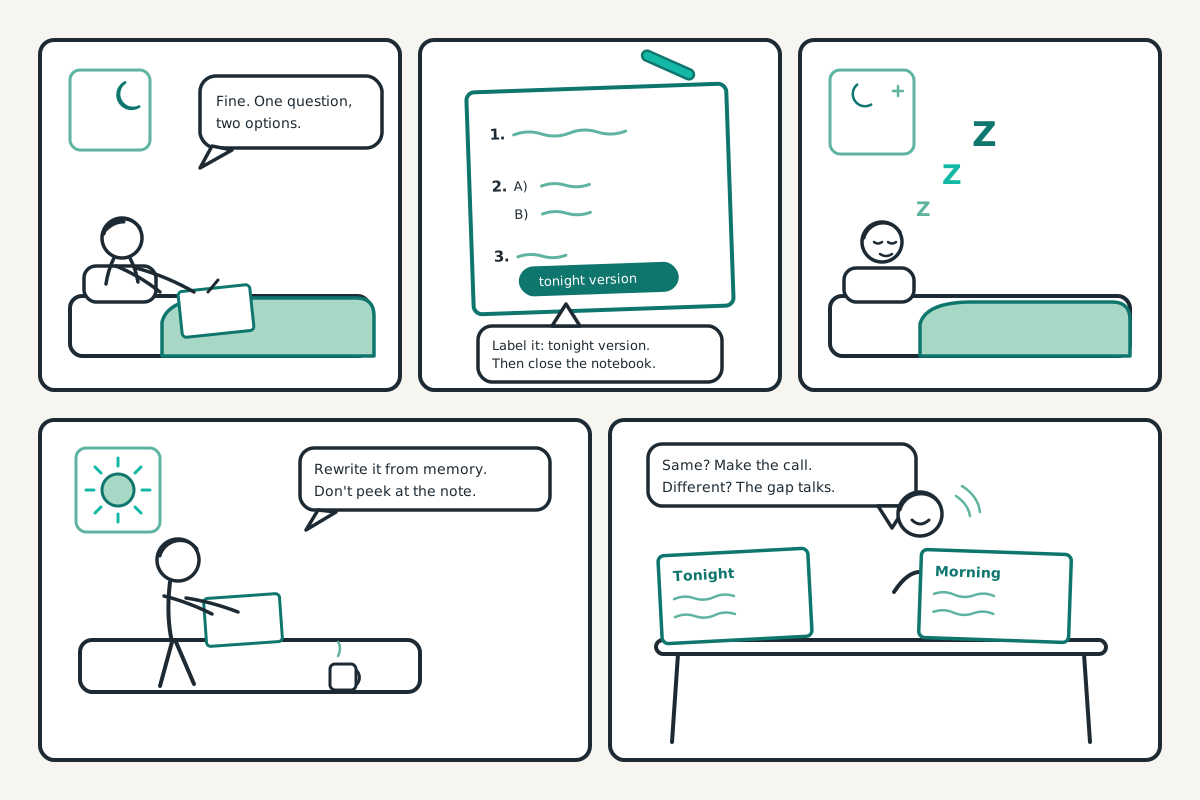
Third, write down which way you're leaning right now, and label the whole thing "tonight version." The label is the trick. You're not committing to anything. You're just pinning down what tonight-you thinks, so tomorrow morning has something to compare against. Tonight-you is often tired, often a little dramatic, often has one eye on the couch. That's fine. That's exactly what we're measuring.
Then close the notebook and go to bed. That's it. No lying awake rehearsing arguments. You already wrote it down; it's on the paper now, not in your head.
The morning version
When you wake up, resist the urge to read last night's note. This part matters. Instead, get your coffee or your shower or whatever your morning looks like, and then — before opening the note — write the problem down again. Same one-sentence problem, your options, and which way you lean now. Label it "morning version."
Fresh judgment is the ingredient that's usually missing when people "sleep on it." The sleep is just the pause button; the fresh judgment is what you're actually after.
Compare the two
Now open both versions and put them side by side.
If they match — tonight-you and morning-you land in the same place — you can probably stop circling. Two passes, twelve hours apart, same answer. That's usually as much certainty as a Tuesday-morning decision is ever going to get. Make the call.
If they don't match, pay attention to how they differ. The gap between the two versions is the real finding. Very often, tonight-you wrote a wish and morning-you wrote a worry, or the reverse. Imagine someone whose tonight version says "take the job offer, it sounds exciting," while the morning version says "take it, but mostly because I'm bored here." Same decision, completely different reasons. The mismatch tells you what the actual question is — excitement versus boredom, in that case — and that's the thing worth sitting with, or worth talking through with someone you trust.
Notice what this is and what it isn't. It's a habit of organizing your thoughts. It separates the emotional weather of the evening from the calmer air of the morning, and it gives you a written record instead of a fog of impressions. It is not a magic process, and it doesn't make hard decisions easy. It just makes your own thinking visible to you, which is more than most people ever bother to do.
When not to sleep on it
A habit like this has limits, and it's worth being honest about them.
If there's a real deadline, sleep is a luxury you may not have. The email that has to go out before the office closes on Friday afternoon doesn't care about your morning ritual. When time is short, use what you have: write the one sentence and the two options, and decide from there.
If safety or money in any serious amount is involved, don't treat a night of sleep as due diligence. A decision about whether to get a strange noise in your car checked before a long drive, or whether to wire money to someone who called you out of the blue — these deserve action, not journaling. Sleep on your thoughts, not on your brakes.
And here's the uncomfortable one: sometimes "let me sleep on it" is just a way of not saying the answer you already know. If you've gone two or three rounds with this habit and the versions keep saying the same thing, but you still haven't acted — the delay isn't the method's fault. At that point, sleeping on it again is just procrastination wearing a bathrobe.
Try it tonight
That's the whole thing. No app, no signup, no test to take.
Tonight, pick one small thing that's been hanging around unresolved — something low-stakes, the kind of decision you've been carrying in the background for a week. Write the one sentence, write your two options, write which way you lean. Label it "tonight version."
Tomorrow morning, before you look, write it again.
Then compare. Most people are surprised by how much their two selves agree — or by exactly where they don't. Either way, you'll know more about your own thinking than you did when you went to bed, and that's usually enough to make the next step obvious.
Join TangoEra on Telegram — daily timing notes and new releases