

The one-page decision memo
There's a decision you've been carrying around for a while. Maybe it's about a job, a move, a relationship, or a project you've been circling for months. You have notes. You have pros and cons lists.
And yet the decision doesn't get made. It just gets revisited.
This post is about one small tool that cuts through that loop: a one-page decision memo. Not a life plan. Not a spreadsheet. One page, written by you, for you — with a date on it.
Why one page
Hard decisions feel hard because everything is in play at once. The salary, the city, the timing, what your friends think, what your past self wanted. When all of that lives in your head, you can't see any of it clearly. You just feel the weight.
One page forces a ranking. You can't fit everything on one page, so you have to decide what actually matters. That act of choosing what to write down is already a decision.
There's also a quieter benefit: a memo is a record. Six weeks from now, when you're doubting yourself, you can reread what you actually thought — not what you remember thinking. Memory edits. The page doesn't.
The seven lines
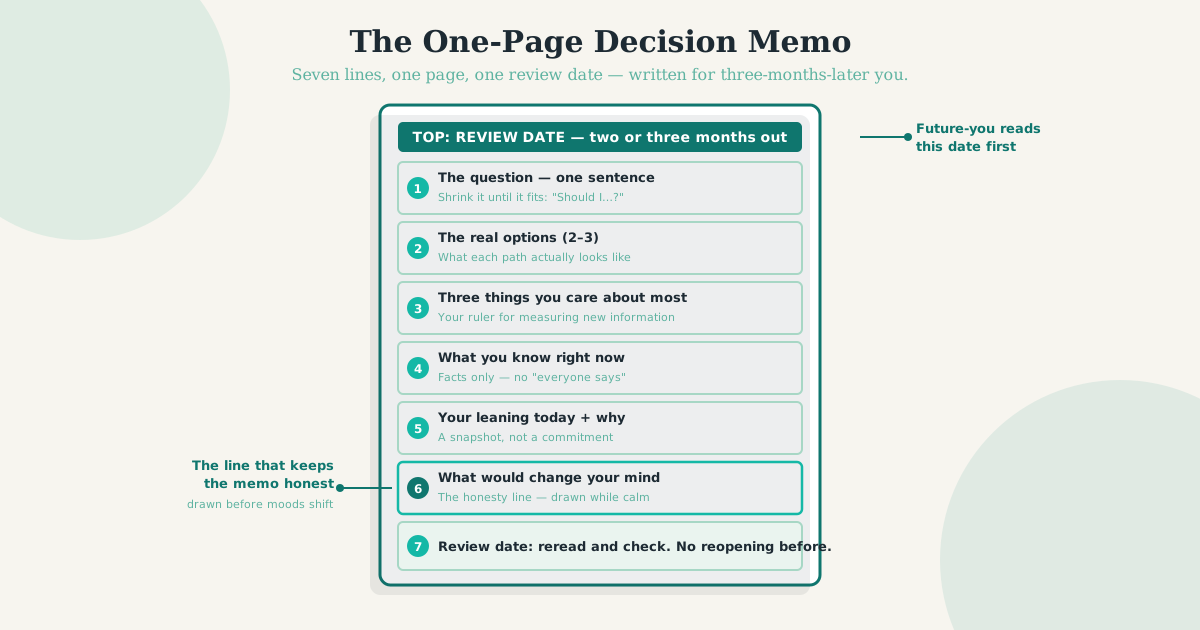
Here's the whole template. Each line gets a sentence or a short list, nothing more.
1. The question, in one sentence. Not the topic — the question. "Should I take the job in the other city?" is a question. "Career stuff" is a fog. If you can't write the question in one sentence, you haven't found the actual decision yet. Keep shrinking it until it fits.
2. The real options. Write down two or three concrete paths. Not "stay or go" in the abstract — what staying actually looks like, what going actually looks like. If you can only write one option, that's a clue you haven't generated real alternatives yet — or that this is really about timing, not choice.
3. The three things you care about most. Not thirty. Three. Maybe it's money, learning, and who you work with. Maybe it's stability, location, and energy left over at the end of the day. Whatever they are, they become your ruler. Later, when new information shows up, you measure it against these three — not against whatever anxiety is loudest that day.
4. What you know right now. Facts only. Not predictions, not other people's opinions dressed up as facts. "The offer is for X." "Rent there is around Y." "I've felt tired for two months." If a sentence starts with "I read somewhere" or "everyone says," it goes in the next draft, not this one.
5. Your current leaning, and the reason. Yes, pick a side. You're allowed to be undecided in life — but on the page, write which way you're leaning today and why. A leaning isn't a commitment. It's a snapshot of your judgment with today's information. When you write the reason down, you'll often discover the reason is thinner than the feeling.
6. What would change your mind. This is the line that makes the memo honest. Write down the specific thing that would flip you. "If they can offer a four-day trial week, I'd take it." "If I get through November without dreading Mondays, I'll stay." You're drawing a line in advance, while you're calm, for the future you who might be panicking or euphoric.
7. The review date. Pick a date — usually two or three months out — and write it at the top. Until that date, the decision is made. You don't reopen it every Tuesday. When the date arrives, you reread the memo and check two things: how the decision turned out, and how good your reasoning was. Sometimes you'll be wrong about the outcome and right about the reasoning. Sometimes the reverse. Both are worth knowing.
Write it for three-months-later you
The most useful shift is imagining the reader. You're not writing for your boss, your friends, or the version of you that wants to look wise. You're writing for the person you'll be in three months — someone who has new information, new moods, and a memory that has quietly rearranged the facts to match the outcome.
That future reader needs three things from you: what you actually knew, what you actually thought, and what you promised would change your mind. Give them those, in plain language, and they'll be able to trust you.
This is also where decision journaling fits in naturally. A decision memo is one entry; a decision journal is the shelf they sit on. If you like the memo format and want to keep a running record of choices and reasons, our guide to decision journaling walks through a simple setup.
A made-up example
Say there's someone — let's call her Mina — deciding whether to leave a stable job to join a small startup. Her memo says: question, "Do I leave Company A for Company B this year?" Options: take it, stay one more year, or negotiate part-time freelance first. Three things she cares about: learning speed, savings buffer, team quality. Facts: the startup has six months of runway; her savings cover eight; two people she trusts rate the founder highly. Her leaning: take it, mostly because she's been coasting for a year. What would change her mind: if the runway drops below four months, or if the founder won't put the equity offer in writing. Review date: March 1.
That whole memo takes twenty minutes. And when March comes, Mina gets to learn from a real record instead of a hazy memory.
Do this today
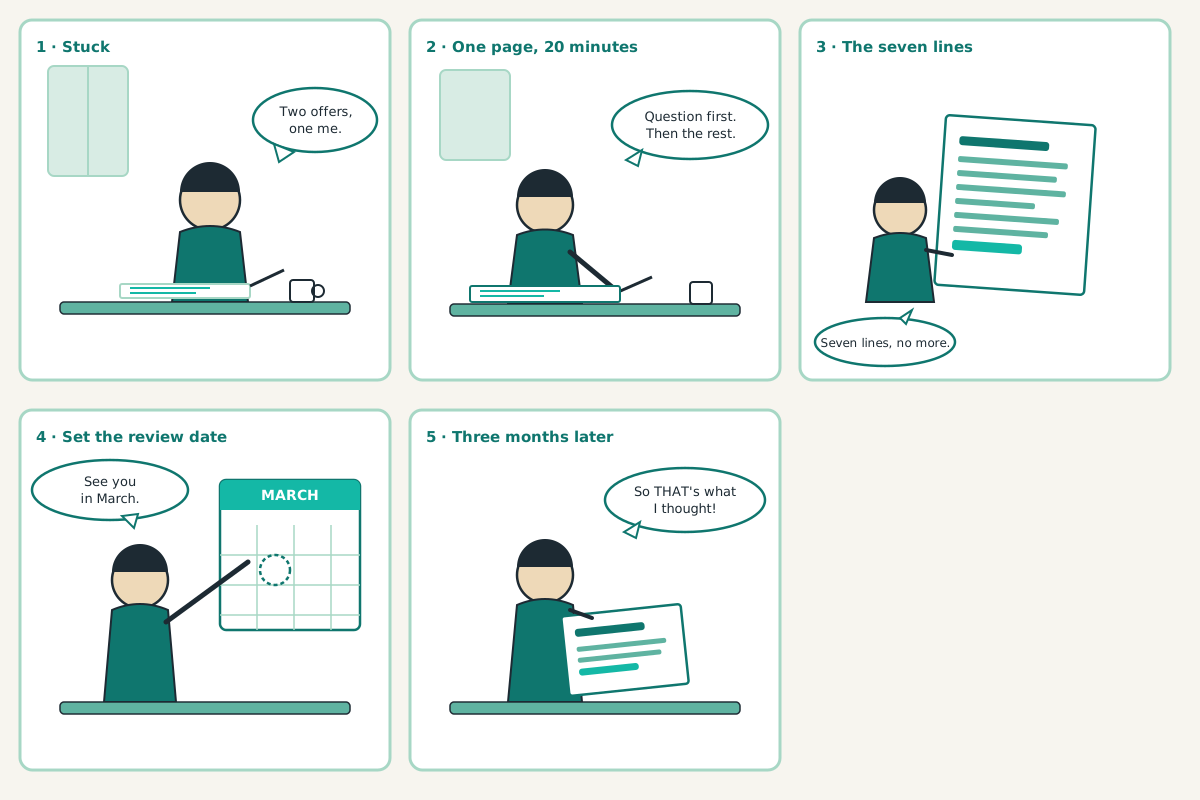
Pick the decision that's been circling longest. Set a timer for twenty minutes and write the seven lines — badly, quickly, by hand if you can. Put a review date on it. Then stop thinking about it until that date arrives.
One page. Twenty minutes. That's the whole assignment.
Join TangoEra on Telegram — daily timing notes and new releases