

The quiet power of defaults
Here's a strange thing about your day. A lot of it was decided before you woke up.
Not by fate. Not by some grand plan. By defaults. The small, silent settings that make choices for you while you're busy thinking about something else.
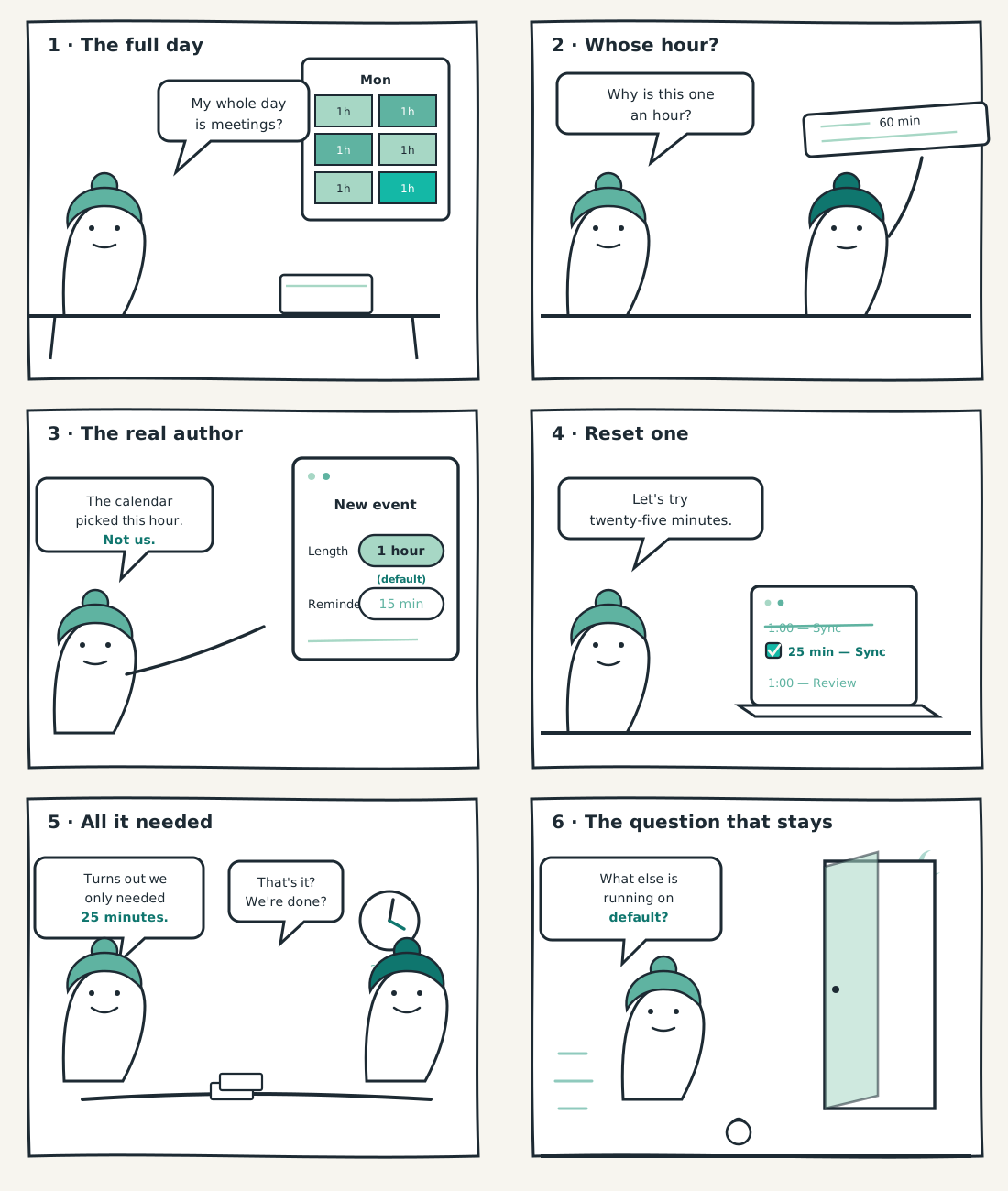
Your phone buzzes at 7am because notifications are on by default. That app charged your card again because auto-renew was the default when you signed up. You took the same route to work you took yesterday. And at 10am you sat down for a one-hour meeting that could have been a message — because many calendar apps default to a sixty-minute meeting, and nobody thought to question it.
None of this is a character flaw. Defaults are not a conspiracy. They're just... quiet.
The choices you never made
Think about how many decisions in a normal day are actually decisions. Real ones, where you stop, weigh two options, and pick.
For many people, the number is smaller than it feels. The rest is autopilot — and autopilot is mostly other people's defaults wearing your clothes.
When you installed that app, someone designed the sign-up screen. They chose which box was checked. They chose what "normal" looked like. You were in a hurry, the checked box looked standard, and you tapped through. That's not a bad decision. It's barely a decision at all. And that's the point.
The meeting length is maybe the best example. Somewhere along the way, calendars decided an hour was the natural unit of gathering. So we fill hours. A question that needs four minutes gets forty, because the box says sixty and nobody wants to be the person who books a "weird" length. The tool set the default. The default set the habit. The habit now feels like your own preference.
It's worth pausing on that: what feels like your preference is sometimes just a setting you never touched.
Why defaults win
Defaults win for a boring reason: they cost nothing. Choosing takes energy. Not choosing takes none. So the path of least resistance isn't laziness — it's design. Every product, every office, every routine is quietly handing you pre-made choices, and your brain, quite reasonably, says "fine" and moves on.
There's nothing wrong with this. Defaults are useful. If you had to truly decide everything — which sock first, which mug, which sentence to say hello with — you'd be exhausted by breakfast. Defaults are the rails your day runs on.
The trouble starts when you forget they're rails. When a setting you never picked starts speaking in your voice. "I guess I'm just not a morning person." Is that true, or is your alarm default just jarring? "I need an hour to meet about this." Do you, or does the calendar? "I always order the same thing." Do you love it, or is it the default option on the menu screen of your habits?
You don't need to answer those questions today. You just need to notice that they're questions.
The audit: three defaults, one week
Here's a small practice. It takes about fifteen minutes to start, and a week to run.
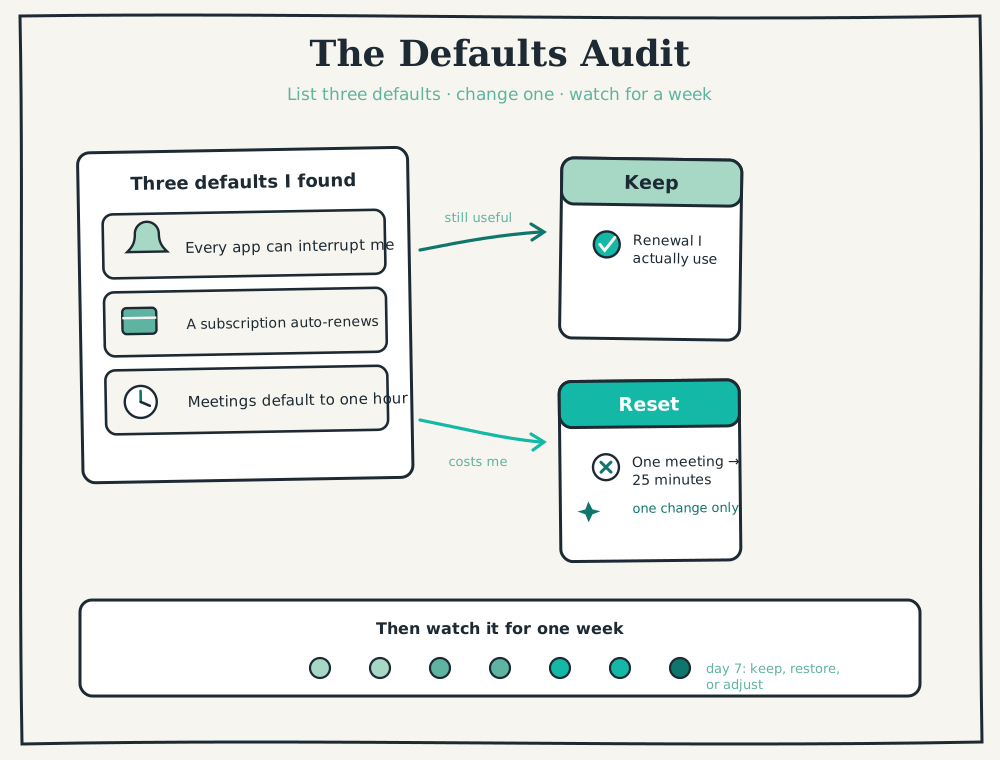
Step one: list three defaults. Not ten. Three. Grab a notebook and write down three places where a default is currently making choices for you. Good hunting grounds:
- Your phone: which apps can interrupt you, and when?
- Your money: what's renewing itself every month without asking?
- Your time: what meetings, routines, or routes run on autopilot?
- Your attention: what's the first thing you look at every morning — and is that your choice?
Don't fix anything yet. Just write three. If you're unsure whether something counts, that's usually a sign it does.
Step two: pick one to reset. Just one. The smallest one. Not the most important — the easiest. Turn off the notifications from the app that interrupts you most. Cancel the subscription you stopped noticing. Change one recurring meeting to twenty-five minutes, or turn it into an email. Cancel one default and see what rushes in to fill the space.
Step three: watch it for a week. This is the step people skip, and it's the one that teaches you something. When you remove a default, you find out whether it was load-bearing. Sometimes the quiet was hiding something useful. Sometimes the hour-long meeting was covering for a decision nobody wanted to own. Sometimes the auto-renew was paying for a thing you genuinely use every week. You don't know until the default is gone and you watch what happens.
At the end of the week, decide. Keep the reset, restore the default, or adjust it. All three outcomes count as success, because now it's a choice. A default you picked on purpose is just called a preference.
What you'll actually learn
A week is short. You won't rebuild your life. But you'll learn something many people rarely check: how much of your day is yours, and how much is just settings.
And here's the quiet dividend. Once you've audited one default, you start seeing them everywhere — not to fix all of them, just to recognize the difference between "this is what I want" and "this is what was pre-selected." That difference, noticed even occasionally, changes the texture of a day. You stop blaming yourself for patterns that were never really decisions. You stop defending choices you never weighed. You just see the machinery a little more clearly.
There's a calm in that. Like finding out the door you never opened wasn't locked — it was just never tried.
Do this today
Open your phone's notification settings. Don't change anything yet — just read the list. Notice which apps have permission to interrupt your thinking, at any hour, without asking.
Pick the one that surprises you most, and turn it off. One app. That's the whole task.
Then tomorrow morning, notice what your attention reaches for when nothing is buzzing.
Join TangoEra on Telegram — daily timing notes and new releases