

The ten heavenly stems, in plain words
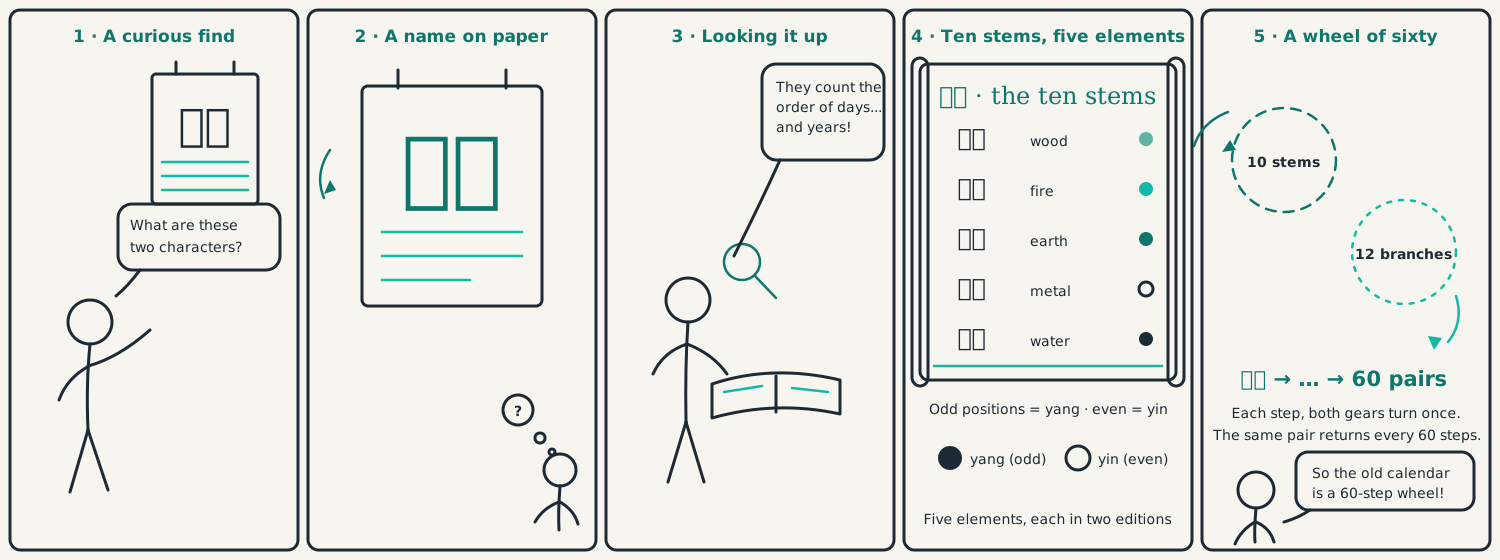
Pick up an old Chinese paper calendar — the kind with red-and-black printing that your grandmother might pin to a kitchen wall — and you may see two small characters next to the date. Something like 甲辰 (jiǎ chén). They look mysterious. They are not mysterious at all. They are part of one of the oldest labeling systems still in everyday use, and once you see how it works, you can read it like a clock.
This is a story about ten characters: a clever way of counting that people in China have used for thousands of years. Day labels written with them already appear on Shang-dynasty oracle bones.
Ten little symbols
The ten heavenly stems (天干, tiān gān) are ten simple glyphs:
甲 乙 丙 丁 戊 己 庚 辛 壬 癸
Say them out loud and they even rhyme a little: jiǎ, yǐ, bǐng, dīng, wù, jǐ, gēng, xīn, rén, guǐ. Think of them as labels, like A, B, C, D — except there are ten of them instead of twenty-six. Ancient scribes used them to mark the order of things: days, items in a list. Before spreadsheets, you needed some way to say "day one, day two, day three," and these ten characters did the job.
Here is the fun part. The stems are not random. They are organized by two ideas at once: the five elements and yin and yang.
Two stems per element
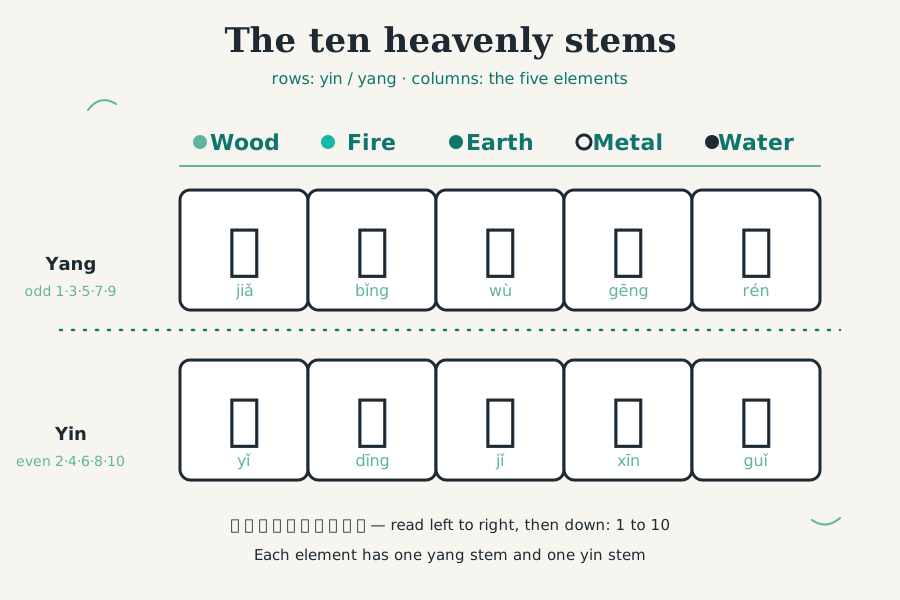
You have probably heard of the five elements (五行): wood, fire, earth, metal, water. In this tradition, each element gets two stems:
- 甲 (jiǎ) and 乙 (yǐ) belong to wood
- 丙 (bǐng) and 丁 (dīng) belong to fire
- 戊 (wù) and 己 (jǐ) belong to earth
- 庚 (gēng) and 辛 (xīn) belong to metal
- 壬 (rén) and 癸 (guǐ) belong to water
One way to picture it: wood is a big tree and a small plant. Fire is a blazing bonfire and a cozy stove. Earth is a mountain and a garden field. Metal is a forged blade and a piece of jewelry. Water is the ocean and a morning dewdrop. Each element has a big version and a small version — and that is exactly where yin and yang come in.
Odd is yang, even is yin
Look at the order of the stems. Count from one:
- 甲 — odd — yang
- 乙 — even — yin
- 丙 — odd — yang
- 丁 — even — yin ...and so on, all the way to 10. 癸.
Every odd position is yang, every even position is yin. So each element naturally ends up with one yang stem and one yin stem: 甲 is yang wood, 乙 is yin wood; 丙 is yang fire, 丁 is yin fire; and so on down the list. The ten stems are really five elements, each appearing in a "loud" and a "quiet" edition.
That is the whole trick. Big-and-small, loud-and-quiet, odd-and-even. A tidy little system.
But why ten? Meet the twelve
Ten is a lovely number, but a cycle of only ten repeats quickly. So the stems were paired with another set of symbols — the twelve earthly branches (地支, dì zhī):
子 丑 寅 卯 辰 巳 午 未 申 酉 戌 亥
In folk custom each branch is also paired with an animal: rat, ox, tiger, rabbit, dragon, snake, horse, goat, monkey, rooster, dog, pig. The branches work exactly like the stems — a repeating label for order.
Now imagine two gears. One gear has ten teeth (the stems), the other has twelve teeth (the branches). Each day — or each year — you advance both gears by one tooth. Because 10 and 12 share a common multiple of 60, the pairings do not repeat until 60 steps. That gives you the cycle called 六十甲子 (sixty jiǎzǐ): sixty unique combinations like 甲子, 乙丑, 丙寅, 丁卯... all the way around.
Remember 甲辰 from the calendar? That is stem 1 paired with branch 5. In the 60-cycle, that slot shows up in years like 2024 — the so-called Year of the Dragon. (Strictly, that lunar year ran from February 2024 to January 2025.) The previous 甲辰 year was 1964, and the next will be 2084. That is all the label says: a position in a great turning wheel.
Counting years, days, and hours
This wheel has been turning for a very long time. Historical records counted years this way, and the system is still used today — you will see the stem-branch year printed on festival posters and new year's envelopes. Days get stem-branch labels too, cycling endlessly: yesterday was one pair, today another, tomorrow the next. In classical texts a scribe could write "on the day 庚申", and a reader who knew the year and month could work out exactly which day was meant. It works like a date stamp that needs no computer.
Ten stems, twelve branches, sixty combinations. No batteries.
A label, not a verdict
Over the centuries, many other ideas were layered on top of the stems. This piece sticks to the counting system itself: ten labels, two per element, alternating yang and yin, turning together with the twelve branches.
The stems are best enjoyed the way you would enjoy an old map projection or a slide rule: a piece of cultural engineering, shaped over centuries, still quietly ticking.
Try it today
Here is your small action. Find the two stem-branch characters on today's date — on a paper calendar, a phone widget, or a search engine — and trace them on the wheel: which stem, which element, which position, odd or even. That is it. You have just read a piece of a machine that is thousands of years old, and it still fits in two characters.
Join TangoEra on Telegram — daily timing notes and new releases