

The 10/10/10 question
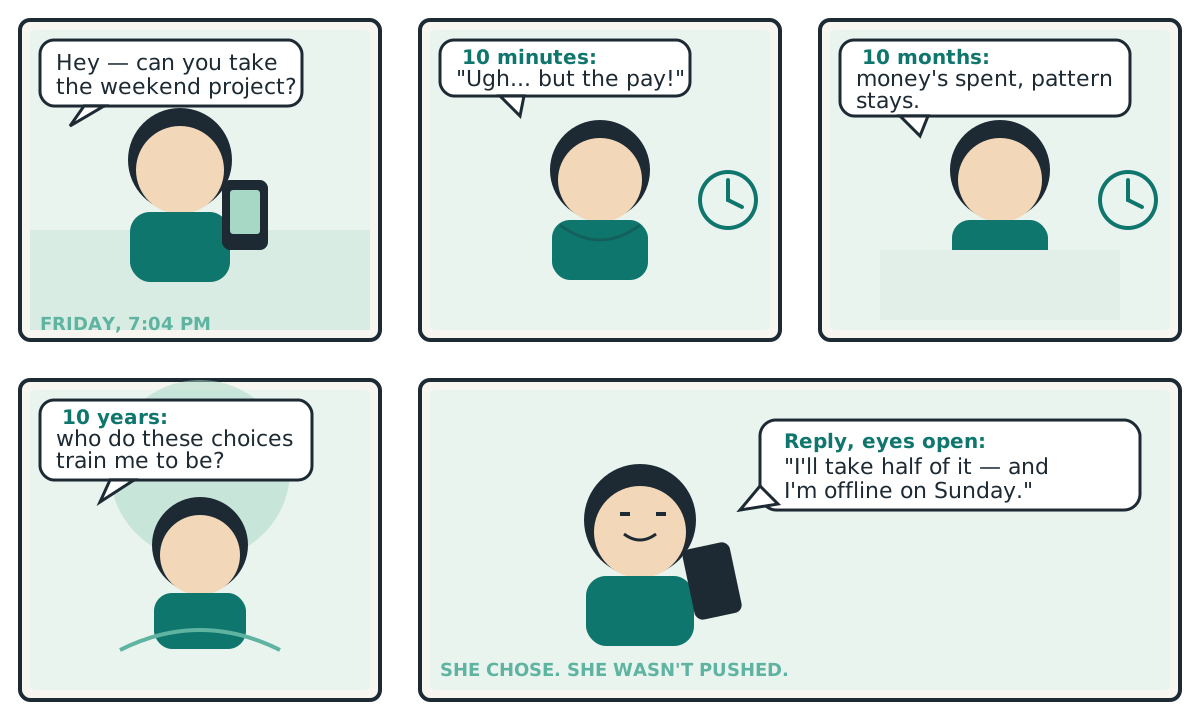
It's Friday evening. Your phone lights up — a colleague asking if you can take a project over the weekend. It pays extra. It also eats your only two free days.
Your chest does the thing it does. The answer starts forming before you've even thought about it.
This is exactly the moment the 10/10/10 question is built for. Three short questions:
How will I feel about this in 10 minutes?
How will I feel about it in 10 months?
How will I feel about it in 10 years?
That's the whole tool. No app, no spreadsheet, no login. Three time scales and thirty seconds of honesty.
Where it comes from
The question became widely known through Suzy Welch, a writer and business journalist who wrote about it as a decision technique. Since then it has shown up in productivity books, coaching sessions, and dinner-table advice all over the place — probably because it's so easy to remember and so cheap to try.
You don't need to read her book to use it. But it's worth knowing the origin, because the question is often sold as more than it is. It isn't a prediction method. It isn't a personality test. It's a framing device — one that does a surprisingly specific job.
What it actually does
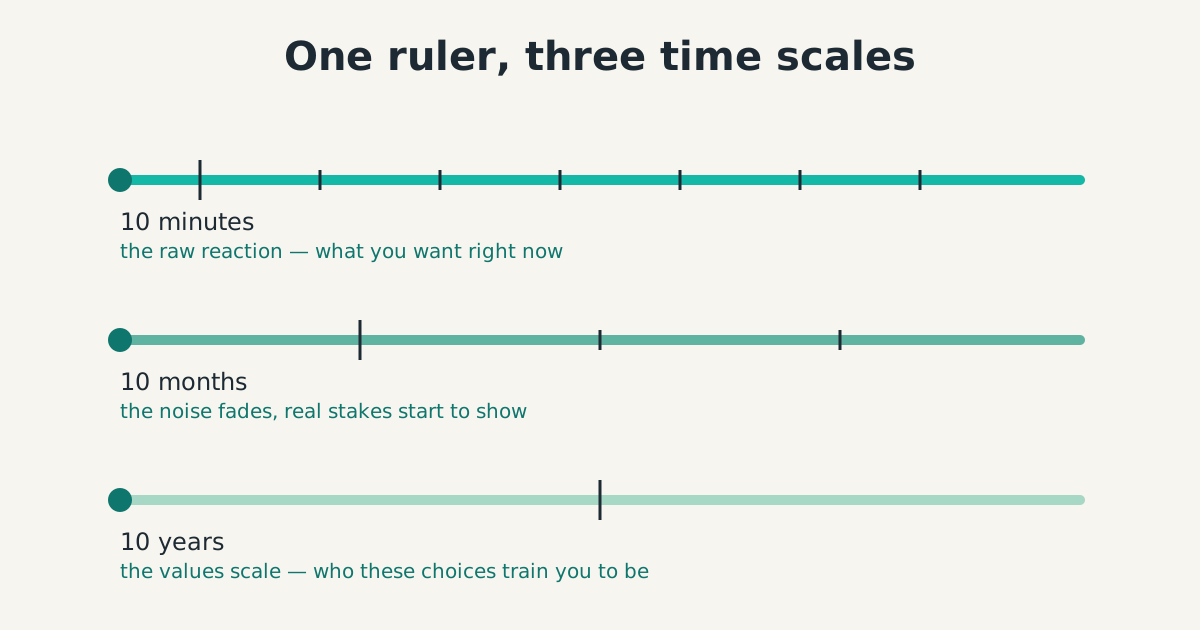
The trick is that your feelings genuinely change across those three scales, and the changes are informative.
Ten minutes is your raw reaction. The flinch, the excitement, the guilt, the "of course I'll do it." This is valuable data — it shows what you want right now, or what you feel pressured to want. Notice it. Don't obey it yet.
Ten months is the first reality check. In ten months, will anyone remember that you worked this one weekend? Will the extra money still be visible in your life? Often the honest answer is: this will be a blurry week among many. Sometimes the answer is: this project is the one that changes my year. The medium scale is where short-term noise fades and real stakes start to show.
Ten years is about values. Not outcomes — values. Ten years from now, you probably won't recall the specific project. But you will be living with the kind of person this choice trains you to be. Someone who says yes by reflex? Someone who protects their rest? Someone who takes the scary good opportunities? The long scale asks: which of those people am I reinforcing?
A concrete example
Imagine someone — let's call her Ana, she's a made-up example — staring at that Friday-evening message.
Ten minutes: she'd feel relieved to say yes. The colleague would be happy, the money would be nice, and she'd avoid the awkwardness of declining. Her first reaction is yes, and it comes mostly from not wanting to disappoint anyone.
Ten months: the weekend is long gone. The money is spent. What remains is the pattern — this is the fourth time this year she's given up a weekend, and she can feel the resentment building in a low-grade, constant way.
Ten years: she wants to be someone with a career she's proud of and a life she actually lives. Both matter. The question doesn't tell her to quit or to take the project. It shows her that her ten-minute answer was about someone else's comfort, while her ten-year answer is about her own life.
She might still say yes. That's allowed. But now she's choosing, instead of being pushed.
Why the three scales matter together
Each scale alone is a trap.
Only ten minutes, and you're ruled by whatever emotion is loudest today — fear, flattery, FOMO, fatigue.
Only ten months, and everything starts to look equally unimportant. Most single decisions do wash out at that distance. You could justify almost anything, or refuse everything.
Only ten years, and everything starts to feel like a test of character. Not everything is a values statement. Sometimes a weekend job is just a weekend job.
Stacked together, the three scales work like a sieve. The ten-minute answer gives you the emotion. The ten-year answer gives you the direction. The ten-month answer keeps both honest.
The limits, plainly
It won't predict the future. Ten years from now, your values may have shifted in ways you can't currently imagine. The question maps your present values onto a longer line — that's all.
It doesn't make the decision for you. Two people can run the same three questions on the same choice and still pick differently. That's not a flaw. The question sorts your reasons; it doesn't crown a winner.
And it can be gamed. If you're determined to take the project, you can narrate all three answers as "fine." The tool only works with the first honest answer at each scale, before your inner lawyer shows up.
When it works best
Use it for the choices that feel sticky — the ones you keep reopening in your head. A purchase you keep almost making. A conversation you keep postponing. A yes you keep giving and regretting.
Skip it for reversible, low-stakes choices. Lunch doesn't need a ten-year horizon.
Do this today
Think of one decision that's been circling you this week. Any size.
Ask yourself the three questions, out loud or on paper. Write one line for each scale — the first honest line, before you edit.
Then do whatever you want. The point isn't to obey the ten-year answer. It's to find out which of your three selves was doing the talking — and to choose with your eyes open.
Join TangoEra on Telegram — daily timing notes and new releases